


Le dernier exemplaire de cette miniature a ete vendu
Ces autres miniatures pourraient vous interesser
Même marque : Peugeot


Même origine : française


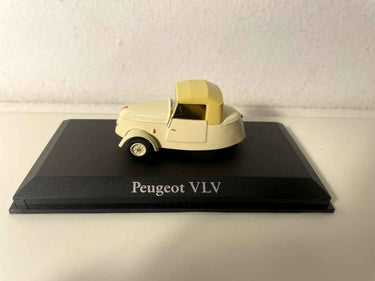


Model Car Peugeot VLV beige (plexi box)
Echelle: 1/43ème

Your payment information is processed securely.
)
This Peugeot VLV miniature in beige color represents one of the most atypical vehicles in the history of French automobiles. This 1/43 scale model perfectly captures the spirit of innovation and adaptation that characterized this troubled period in French history.
A true collector's piece, this faithful reproduction is aimed at enthusiasts of French automobiles and collectors wishing to own a rare witness to French automotive ingenuity during wartime.
Miniature features
- Model: VLV (Light City Vehicle)
- Brand: Peugeot
- Year: 1941-1943
- Scale: 1/43
- Color: Beige
- Protective case included: Yes
The Peugeot VLV: a response to scarcity
The Peugeot VLV was born in 1941 during a particularly difficult context. In the face of the gasoline shortage affecting occupied France, Peugeot developed this revolutionary electric vehicle to maintain urban mobility. This small electric car, designed in haste, represented a pragmatic solution to the fuel restrictions imposed by the German occupier.
With its compact dimensions and simplified design, the VLV could carry two adults and some luggage over urban distances. Its electric motor of 3.5 horsepower allowed it to reach 35 km/h and offered a range of about 80 kilometers, remarkable performance for the time given the technical constraints.
Despite its limited production of about 377 units, this model marked history as the first mass-produced electric car in France. Its high price and difficulties in sourcing batteries limited its distribution, but its pioneering concept is a testament to the adaptability of the French automotive industry.
Peugeot in wartime: innovation and resilience
During World War II, Peugeot demonstrated remarkable adaptability. The lion brand, founded in 1810 and becoming an automobile manufacturer in 1889, had to reinvent its production in the face of the restrictions imposed by the occupation. The development of the VLV perfectly illustrates this period of constrained innovation.
The family business, then led by the Peugeot dynasty, refused collaboration and suffered numerous requisitions of factories. Paradoxically, it was in this challenging context that bold projects such as the VLV were born. This dark period in French history reveals the ingenuity of Peugeot engineers, capable of designing innovative technical solutions despite material constraints.
The Sochaux-based brand, bolstered by its experience in metallurgy and precision mechanics, applied its traditional know-how to this new electric drive. This capacity for innovation in adversity foreshadows the pioneering spirit that would later characterize Peugeot in modern automobiles.
The anecdote of the forgotten pioneer
The Peugeot VLV hides a fascinating story that resonates remarkably with our current concerns. In 1941, while the world was just starting to discover the stakes of sustainable mobility, Peugeot unknowingly invented the modern urban electric car. This small battery-powered city car foreshadowed today's electric Smarts and Citroën Amis, nearly 80 years ahead of its time.
The irony of history is that this vehicle, designed out of necessity rather than ecological awareness, already offered the features sought after today: zero local emissions, silent operation, and optimized urban use. The engineers of 1941 had solved, with the means of the time, problems that the automotive industry is rediscovering today with massive electrification.
Even more surprisingly, the VLV had a domestic charging system, anticipating eight decades the democratization of home charging. The owners of this technical curiosity were probably the first "electromobilists" in history, unknowingly experimenting with the mobility of tomorrow in the dramatic context of the Occupation.
This involuntary technical foresight makes the Peugeot VLV a touching symbol of French innovation: capable of revolutionizing the automobile through pragmatism, even before fully grasping its historical significance. A small vehicle that, by its mere existence, demonstrates that the best innovations often arise out of necessity.
Complete your collection of French miniatures
This Peugeot VLV miniature occupies a unique place in the world of collectors. It represents an unknown yet fascinating part of French automotive history, a period when innovation arose from constraint. For fans of French miniatures, this model is an irreplaceable testimony to tricolor ingenuity.
This miniature fits perfectly into a collection dedicated to 1940s automobiles or exceptional vehicles. It harmoniously interacts with other French rarities from the time, creating a coherent ensemble that tells the story of French automobiles in times of crisis. Collectors will appreciate its complementarity with Citroën or Renault models from the same period.
Intended for automotive history enthusiasts and discerning collectors, this Peugeot VLV also attracts fans of 1/43 scale miniatures. Its unique character and protective case make it a choice piece for enriching any serious collection, bearing witness to the pioneering spirit of French electric automobiles.
Frequently Asked Questions
How to understand the scales of miniatures?
Scale indicates the reduction ratio between the real car and the miniature. For example, at 1:43 scale, each centimeter on the miniature corresponds to 43 centimeters on the real vehicle.
Concretely, a 1/18 scale Ferrari model is approximately 25-30 cm long, while in 1/43 scale it measures approximately 10 cm.
What scales are available?
Our model cars are mainly offered in 1/43, 1/24, 1/18 and 1/87 (HO) scales. The scale is always indicated in the product sheet.
The smaller the second number, the larger the model car (e.g. 1/18 is larger than 1/43).
Does the model car come with protection?
Yes, each model car is systematically delivered in its protective box. This box preserves the collectible value and protects your model car from dust and shocks.
How is my package protected during transport?
We package each order with the utmost care: bubble wrap, appropriate cushioning, and polystyrene. Your model car is perfectly secure during its journey.
What is the delivery time?
In-stock items are shipped within 24-48 hours. Please allow 2-3 business days for France via Colissimo or 4-5 days via Mondial Relay.
The model car is no longer in stock, when will you have it?
It's impossible for me to know exactly when I'll receive a new stock because I receive arrivals in dribs and drabs. Please contact me so I can keep you informed as soon as it's available.
What our customers say
Customer feedback and testimonials