


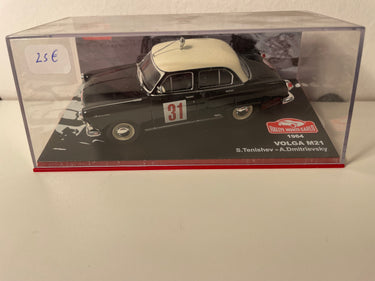


Model Car Volga M21 black with beige roof number 31 - 1964 Monte Carlo Rally
Echelle: 1/43ème
Pilotes: S. Tenishev / A. Dmitrievsky

Your payment information is processed securely.

Chargement de vos recommandations...
Discover this magnificent Volga M21 black with beige roof number 31, a faithful miniature of the car that marked the 1964 Monte Carlo Rally. Driven by the Soviet crew S. Tenishev and A. Dmitrievsky, this iconic sedan exemplifies the boldness of Eastern manufacturers daring to challenge Western standards on the most demanding roads in Europe.
This reproduction in 1/43 scale perfectly captures the understated elegance and robustness characteristic of this Soviet model, a true symbol of an era where the automobile was as much a geopolitical issue as a sporting one.
Features of the miniature
- Model: Volga M21
- Brand: GAZ (Gorky Automobile Plant)
- Year: 1964
- Scale: 1/43
- Color: Black with beige roof
- Race number: 31
- Protective case included: Yes
The Volga M21, Soviet ambassador
Launched in 1956, the Volga M21 represented the elite of Soviet automobiles, intended for party officials and dignitaries. This four-door sedan marked a break from the usual austerity of Eastern vehicles, offering an unprecedented level of comfort and finish for the time. Its design, inspired by American aesthetic codes of the 1950s, reflected a desire for openness while maintaining a distinctly Soviet identity.
Technically, the M21 distinguished itself through its exemplary robustness and reliability, essential qualities for facing the extreme weather conditions of the USSR. Its 2.4-liter four-cylinder engine delivered modest but sufficient power, while its suspension and transmission were designed to withstand failing roads. These advantages made it a natural candidate for rally events, where endurance took precedence over pure performance.
The commercial success of the M21 surpassed Soviet borders, with the model being exported to many countries in the Eastern bloc as well as Western Europe, where its reputation for durability earned it a loyal clientele among professionals and enthusiasts of atypical automobiles.
GAZ, the flagship of Soviet automotive industry
In 1964, the Gorky Automobile Plant (GAZ) was at the height of its artistry, bolstered by three decades of experience in car production. Founded in 1932 with technical assistance from Ford, the company quickly gained its technological independence to become the spearhead of the Soviet automotive industry. In the context of the Cold War, each GAZ model bore a political dimension, serving as a technological showcase to demonstrate the industrial capabilities of the USSR.
The 1960s marked the golden age of GAZ, diversifying its production between civilian, military, and utility vehicles. The Volga M21 perfectly embodied this upscale evolution, positioned as the Soviet answer to Western sedans. Gorky engineers successfully adapted foreign technologies to local specifications, creating unique vehicles in their design. This industrial philosophy allowed GAZ to compete with Western manufacturers in certain segments, notably that of robust vehicles meant for demanding usage conditions.
A little-known saga of rallying
The participation of the Volga M21 in the 1964 Monte Carlo Rally was part of a prestige strategy orchestrated by the Soviet authorities. At a time when every sporting victory was instrumentalized in the Cold War, the involvement of Soviet cars on European roads was of paramount importance. The Tenishev/Dmitrievsky crew embodied this ambition, with these seasoned drivers being specially selected to represent Soviet automotive excellence.
The contrast was striking between this imposing black sedan and the European sports cars that traditionally dominated the Monégasque event. The Volga M21, with its massive lines and official car look, stood out in the rally landscape. Yet, its legendary robustness and the skill of its drivers allowed it to finish honorably in this demanding event known for its technical challenges and selectivity.
This participation also marked the gradual opening of Soviet motorsport to the international scene. Long confined to national competitions, Eastern drivers began to venture onto the European stage, bringing with them a different approach to competition that prioritized regularity and reliability over pure speed. This philosophy, inherited from the specific conditions of their home country, sometimes proved advantageous in endurance events like Monte Carlo.
The cultural impact of these participations exceeded purely sporting boundaries. These mechanical ambassadors contributed to changing the image of Soviet automobiles in the West, demonstrating that the Eastern industry was capable of producing vehicles worthy of the greatest international competitions, challenging some of the prejudices of the time.
Complete your collection of historical miniatures
This Volga M21 occupies a unique place in the world of rally miniatures, representing a little-known yet fascinating chapter of motor racing history. It fits perfectly into collections dedicated to rally cars or 1960s automobiles, bringing valuable geographical and cultural diversity.
For collectors passionate about automotive history, this miniature naturally converses with other emblematic models of the time, whether they are cars from the 24 Hours of Le Mans or classics from 1950 to 1979. It also finds its place alongside other historic sedans that marked their era.
This reproduction appeals to both enthusiasts of historical miniatures and automobile geopolitics aficionados, testifying to a time when the automobile was a vehicle for national assertion. It also serves as an excellent entry point into the little-known world of foreign cars and other international brands, enriching any collection with its uniqueness and historical authenticity.
Même compétition : rallye


Même origine : autres marques étrangères


Frequently Asked Questions
How to understand the scales of miniatures?
Scale indicates the reduction ratio between the real car and the miniature. For example, at 1:43 scale, each centimeter on the miniature corresponds to 43 centimeters on the real vehicle.
Concretely, a 1/18 scale Ferrari model is approximately 25-30 cm long, while in 1/43 scale it measures approximately 10 cm.
What scales are available?
Our model cars are mainly offered in 1/43, 1/24, 1/18 and 1/87 (HO) scales. The scale is always indicated in the product sheet.
The smaller the second number, the larger the model car (e.g. 1/18 is larger than 1/43).
Does the model car come with protection?
Yes, each model car is systematically delivered in its protective box. This box preserves the collectible value and protects your model car from dust and shocks.
How is my package protected during transport?
We package each order with the utmost care: bubble wrap, appropriate cushioning, and polystyrene. Your model car is perfectly secure during its journey.
What is the delivery time?
In-stock items are shipped within 24-48 hours. Please allow 2-3 business days for France via Colissimo or 4-5 days via Mondial Relay.
The model car is no longer in stock, when will you have it?
It's impossible for me to know exactly when I'll receive a new stock because I receive arrivals in dribs and drabs. Please contact me so I can keep you informed as soon as it's available.
What our customers say
Customer feedback and testimonials