


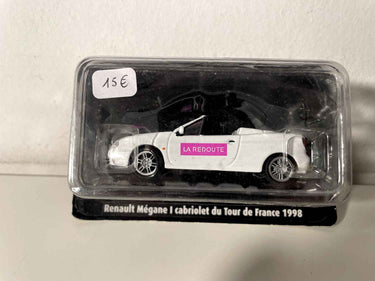


Model Car White Renault Mégane 1 convertible "La Redoute" from the 1998 Tour de France
Scale 1/43

Your payment information is processed securely.


Chargement de vos recommandations...
Discover this exceptional white Renault Mégane 1 convertible "La Redoute" diecast model car that immortalizes the legendary 1998 Tour de France. This meticulously crafted miniature replica at 1/43 scale captures the spirit of one of cycling's most memorable editions, when Marco Pantani triumphed in a season marked by sporting glory and national pride. For collectors of diecast model cars and enthusiasts of French cycling history, this piece represents an authentic slice of automotive and sporting heritage that deserves a prominent place in any collection.
This high-quality diecast model car faithfully reproduces every detail of the original advertising vehicle that accompanied the Grande Boucle during that unforgettable summer. The white livery adorned with La Redoute's distinctive branding immediately evokes the festive atmosphere of the publicity caravans that have enchanted spectators along French roads for nearly a century. As a must-have collector's item, this miniature represents both the golden age of French mail-order retail and the enduring tradition of the Tour de France advertising spectacle.
Technical Specifications of This Diecast Model Car
This precision-engineered scale model showcases the exceptional craftsmanship that distinguishes premium diecast model cars in today's collectibles market:
- Model: Renault Mégane 1 convertible "La Redoute"
- Manufacturer: Renault
- Year represented: 1998 Tour de France
- Scale: 1/43rd - the classic standard for automotive miniatures
- Livery: White with authentic La Redoute markings and graphics
- Materials: High-quality die-cast metal construction with detailed plastic components
- Protective display case: Included to preserve your investment
- Finish: Professional-grade paint application with precise tampo printing
The Renault Mégane Convertible: A Design Icon of the 1990s
Launched in 1995 as Renault's replacement for the aging R19, the first-generation Renault Mégane marked a revolutionary stylistic transformation for the French manufacturer. Under the visionary leadership of design director Patrick Le Quément, the Mégane family introduced flowing, organic shapes that broke dramatically with the angular aesthetics that had dominated European automotive design throughout the 1980s. This bold new direction positioned Renault as a design innovator, challenging German manufacturers' domination of the European market.
The convertible version, introduced to the market in 1997, perfectly embodied the spirit of freedom and optimism that characterized late 1990s European culture. Distinguished by its electric fabric roof mechanism and balanced proportions, the Mégane Cabriolet quickly established itself as one of the most attractive and practical compact convertibles of its generation. Unlike some convertibles that sacrificed structural rigidity for open-air motoring, the Mégane maintained excellent dynamic qualities and everyday usability.
Equipped with a range of petrol engines from 1.4 to 2.0 liters, the Mégane Cabriolet offered an ideal compromise between driving pleasure and practical considerations. The most popular variants featured the 1.6-liter 16-valve engine, which delivered 110 horsepower—sufficient for spirited driving while maintaining reasonable fuel economy. The convertible's balanced chassis tuning provided engaging handling characteristics without compromising comfort, making it equally at home on winding country roads or urban boulevards.
The selection of this model to represent La Redoute in the Tour de France vehicles fleet was far from arbitrary. Its elegant silhouette, youthful image, and ability to convey accessibility perfectly aligned with the marketing objectives of advertising caravan participants. The convertible format also maximized visibility for promotional staff, allowing them to interact more effectively with roadside spectators while distributing branded merchandise and creating memorable moments.
Renault's Renaissance Period: Innovation and Success in 1998
The year 1998 represented a pivotal moment in Renault's corporate evolution, as the French diamond brand underwent a period of remarkable creative and commercial renewal. Under Patrick Le Quément's influential design direction, the company revolutionized its aesthetic philosophy with models featuring bold, unconventional shapes that radically departed from previous conservative production. This design revolution extended beyond the Mégane to encompass the entire product range, including the curvaceous Twingo city car, the innovative Scenic compact MPV, and the elegant Laguna sedan.
In the marketplace, Renault consolidated its position as a European leader through the outstanding success of multiple model lines. The Renault Clio dominated the supermini segment, while the Mégane family captured significant market share in the crucial compact class. The revolutionary Scenic, launched in 1996, virtually created the compact MPV segment and became one of Europe's best-selling vehicles, demonstrating Renault's ability to identify and fulfill emerging consumer needs.
Beyond passenger cars, 1998 marked Renault's preparations for a triumphant return to Formula 1 as an engine manufacturer. This strategic decision would herald a decade of extraordinary sporting success, culminating in Fernando Alonso's back-to-back World Championships in 2005 and 2006, along with consecutive Constructors' Championships for the Renault F1 Team. This motorsport excellence reinforced the brand's engineering credentials and youthful, dynamic image in the minds of European consumers.
The corporate strategy of moving upmarket while maintaining volume leadership enabled Renault to compete effectively with German premium manufacturers in innovation, design quality, and technological advancement. Investments in research and development yielded breakthroughs in safety systems, engine efficiency, and comfort features, establishing Renault as a technology leader rather than merely a value alternative.
The Tour de France Publicity Caravan: A Unique French Cultural Institution
The presence of the Renault Mégane "La Redoute" diecast model car in representations of the 1998 Tour de France connects to a venerable tradition spanning nearly a century. The legendary advertising caravan, born in 1930 when Tour director Henri Desgrange sought alternative funding sources for the race, has evolved into a spectacular show in its own right. Preceding the riders by approximately 90 minutes to two hours, this colorful procession of branded vehicles distributes millions of promotional items to enthusiastic spectators gathered along thousands of kilometers of French roadways.
The 1998 edition of the Tour de France held particular cultural and sporting significance for France. Held entirely within French borders to celebrate the nation's hosting of the FIFA World Cup—which France would ultimately win—the Tour unfolded against a backdrop of unprecedented national sporting euphoria. La Redoute, the iconic mail-order company based in Roubaix in northern France, had selected the Renault convertible to project an image of modernity, accessibility, and proximity to French families throughout the country.
That memorable summer, Italian climber Marco Pantani captured his only Tour de France victory in a stunning finale that saw him overtake German rider Jan Ullrich in the final mountain stages. Pantani's triumph made him the last rider to achieve the prestigious Giro d'Italia-Tour de France double in a single season—a feat considered virtually impossible in the modern era of specialized racing calendars. Promotional vehicles like this Mégane convertible contributed fully to the festive, carnival atmosphere that characterized this legendary edition, creating indelible memories for millions of roadside spectators.
The economic impact of the publicity caravan extends far beyond simple brand exposure. Participating companies invest heavily—often between 80,000 and 150,000 euros per Tour—to reach an audience estimated at 12 million roadside spectators and hundreds of millions of television viewers worldwide. For brands seeking to connect with French consumers in an authentic, emotionally resonant context, no marketing platform compares to the Tour de France caravan's combination of reach, engagement, and cultural significance.
Today, these Tour de France advertising vehicles serve as privileged witnesses to an era when commercial messaging blended harmoniously with sporting spectacle, creating a uniquely French cultural phenomenon. New generations discover this tradition with wonder through faithfully reproduced diecast model cars that preserve the memory of iconic promotional vehicles and the brands they represented during cycling's golden age.
Understanding Diecast Model Car Collecting: A Growing Global Phenomenon
The market for diecast model cars has experienced remarkable growth in recent years, evolving from a childhood hobby into a sophisticated collectibles sector valued at billions of dollars globally. Industry research indicates that over 320 million diecast model car units were sold worldwide in 2024, with adult collectors accounting for approximately 60% of purchases. This demographic shift reflects the maturation of the hobby, with enthusiasts aged 25-60 driving demand for high-quality, limited-edition miniatures.
Several factors contribute to the sustained popularity of collecting automotive diecast model cars. Nostalgia plays a significant role, as collectors seek to recapture childhood memories or own representations of vehicles they admired but could never acquire in full scale. The investment potential of rare and limited-edition models has also attracted new collectors, with certain pieces appreciating by 300% or more within just a few years of release. The rise of online marketplaces and social media communities has facilitated connections between collectors worldwide, creating a vibrant global network of enthusiasts.
The 1/43 scale represented by this Renault Mégane model has historically been the most popular format for diecast model cars, offering an optimal balance between detail, display requirements, and affordability. This scale allows manufacturers to incorporate impressive levels of accuracy—including detailed interiors, realistic suspension components, and authentic badging—while maintaining accessibility for collectors with limited display space. Many serious collectors focus their collections around the 1/43 scale, creating comprehensive representations of specific manufacturers, racing series, or historical periods.
Technological advances in manufacturing have dramatically improved the quality and realism of modern diecast model cars. Computer-aided design enables unprecedented accuracy in reproducing original vehicle proportions and details. Advanced paint application techniques deliver authentic color matching and complex graphics reproduction. Photo-etched metal parts, separately molded plastic components, and even working suspension systems elevate premium models to museum-quality miniature sculptures that justify premium pricing.
The Art of Display and Preservation for Diecast Model Cars
Proper display and preservation techniques are essential for maintaining both the aesthetic appeal and investment value of diecast model cars. The included protective case for this Renault Mégane model provides essential protection against dust accumulation, ultraviolet light exposure, and physical damage—the three primary threats to miniature collectibles. However, serious collectors should consider additional measures to ensure long-term preservation.
Environmental conditions significantly impact diecast model car longevity. Excessive heat can cause paint degradation and plastic component warping, while high humidity may lead to metal oxidation and decal deterioration. Ideal storage conditions maintain temperatures between 18-22°C (64-72°F) and relative humidity levels of 40-50%. Direct sunlight exposure should be avoided entirely, as ultraviolet radiation causes irreversible fading of paint and printed graphics, potentially devastating a model's value and appearance.
Display solutions for diecast model car collections range from simple wall-mounted shelving to sophisticated climate-controlled display cabinets with integrated LED lighting. Many collectors organize their displays thematically—grouping models by manufacturer, era, scale, or subject matter. Tour de France advertising vehicles like this Mégane convertible create particularly compelling displays when grouped with other caravan vehicles, racing support cars, or period-appropriate French automotive miniatures.
Documentation and authentication also play crucial roles in serious diecast model car collecting. Maintaining original packaging, certificates of authenticity, and production documentation enhances both the historical significance and resale value of collectible models. For limited-edition releases, numbered certificates and special presentation packaging often constitute an integral component of the collectible package, deserving careful preservation alongside the model itself.
Expanding Your Tour de France Vehicle Collection
This Renault Mégane 1 convertible "La Redoute" diecast model car naturally finds its place alongside other iconic advertising vehicles that have graced the Tour de France publicity caravan throughout its nine-decade history. It harmonizes perfectly with other promotional vehicles, creating a cohesive ensemble that traces the evolution of marketing strategies in competitive cycling and showcases the changing face of French advertising culture.
For collectors passionate about the Renault universe, this convertible represents an ideal complement to other first-generation Mégane variants available in 1/43 scale. The complete Mégane family included sedan, coupe, estate, and scenic MPV body styles, each offering distinct styling characteristics while sharing the revolutionary design language that defined Renault's 1990s renaissance. Assembling the complete range provides fascinating insights into product line development and marketing differentiation strategies.
Beyond automotive enthusiasts, this diecast model car appeals to cycling enthusiasts and those nostalgic for the 1990s—a transformative period when the Tour de France achieved unprecedented global media exposure while maintaining its essential character as a distinctly French cultural phenomenon. The model bears witness to an era when sport, advertising, and French lifestyle harmoniously combined on roads winding through picturesque villages and over legendary mountain passes.
Complementary collection opportunities include other 1998 Tour de France publicity vehicles, contemporary Renault production models, French promotional vehicles from various sporting events, and advertising cars representing La Redoute across different periods. Each addition enriches the narrative context surrounding this Mégane convertible, transforming individual models into components of a broader story about French automotive design, sporting culture, and commercial creativity.
Investment Potential and Market Trends for Advertising Vehicle Models
The market for Tour de France advertising vehicle diecast model cars represents a fascinating niche within the broader collectibles market. Unlike mainstream production car models, promotional vehicle miniatures appeal to multiple collecting communities simultaneously—automotive enthusiasts, cycling fans, advertising memorabilia collectors, and nostalgia-focused buyers. This cross-market appeal creates robust demand and supports value appreciation for well-preserved examples.
Limited production runs characterize most promotional vehicle models, as manufacturers typically produce these specialized subjects in smaller quantities than mainstream automotive subjects. This inherent scarcity, combined with the passionate collector base surrounding Tour de France memorabilia, creates favorable conditions for long-term value retention. Models representing iconic brands or particularly memorable Tour editions tend to appreciate most significantly, especially when maintained in pristine condition with original packaging.
Market analysis indicates that vintage Tour de France promotional vehicle models from the 1950s through 1980s have experienced substantial appreciation, with certain rare examples commanding prices 500-1000% above their original retail values. While models from the 1990s and later haven't yet achieved comparable appreciation, they represent accessible entry points for new collectors while offering solid long-term potential as they age and become increasingly difficult to acquire.
Why This Diecast Model Car Deserves a Place in Your Collection
This white Renault Mégane 1 convertible "La Redoute" diecast model car transcends its modest size to embody multiple compelling narratives. It represents a specific moment in automotive design history when French manufacturers challenged industry conventions with bold, organic styling. It commemorates one of cycling's most memorable seasons, when sporting achievement intersected with national celebration. It preserves the memory of La Redoute, an iconic French retail brand that shaped shopping habits for generations.
The model's 1/43 scale provides impressive detail while maintaining display-friendly proportions. The authentic livery reproduction captures the visual identity that made this vehicle memorable to millions of roadside spectators. The included protective case facilitates both preservation and presentation, allowing collectors to safeguard their investment while showcasing this distinctive piece.
For enthusiasts of French automotive design, Tour de France history, 1990s nostalgia, or promotional vehicle collecting, this Renault Mégane diecast model car offers exceptional value. It serves equally well as a standalone display piece or as a foundation for broader collection development. Whether displayed in a home office, integrated into an extensive automotive miniature collection, or preserved as an investment piece, this model delivers lasting satisfaction.
The Enduring Appeal of Tour de France Collectibles
The Tour de France's status as the world's largest annual sporting event ensures enduring interest in associated memorabilia and collectibles. Unlike many sporting competitions that appeal primarily to dedicated fans, the Tour functions as a national celebration that transcends pure sporting interest. This broad cultural significance creates sustained demand for Tour-related collectibles, including diecast model cars representing vehicles associated with the race.
Advertising caravan vehicles hold particular appeal because they represent the accessible, family-friendly face of the Tour de France. While professional cyclists remain somewhat distant figures to most spectators, the promotional vehicles engage directly with crowds, creating personal memories that endure for decades. Miniature reproductions of these vehicles allow collectors to recapture those magical moments when a favorite product's promotional car passed by, distributing samples and generating excitement.
As the Tour de France approaches its centenary and beyond, historical artifacts and representations gain increasing cultural and monetary value. Models like this 1998 Renault Mégane convertible document specific moments in the race's evolution, preserving details of promotional partnerships, vehicle designs, and cultural contexts that might otherwise be lost to time. For historians, researchers, and enthusiasts, these diecast model cars serve as three-dimensional historical documents worthy of preservation and study.
Frequently Asked Questions About This Diecast Model Car
What makes 1/43 scale ideal for diecast model cars?
The 1/43 scale has emerged as the classic standard for diecast model car collecting due to its optimal balance of detail, display requirements, and affordability. At this scale, a full-size vehicle measuring approximately 4.3 meters reduces to roughly 10 centimeters, allowing impressive detail incorporation while remaining compact enough for practical display and storage. Manufacturers can include authentic interiors, realistic suspension components, and accurate badging at this scale, creating miniatures that satisfy serious collectors while remaining accessible to enthusiasts with limited space or budgets.
How should I clean and maintain my diecast model cars?
Proper maintenance preserves both appearance and value of diecast model cars. Remove accumulated dust using a soft, dry brush or compressed air rather than direct contact cleaning, which might scratch paint or dislodge delicate parts. For more stubborn dirt, slightly dampen a microfiber cloth with distilled water and gently wipe surfaces, avoiding decals and printed graphics. Never use chemical cleaners, as they may damage paint, plastic components, or tampo printing. Handle models by their base or chassis rather than delicate components like mirrors or antennas. Store in protective cases away from direct sunlight and maintain stable environmental conditions to prevent deterioration.
Are Tour de France promotional vehicle models good investments?
Tour de France promotional vehicle diecast model cars can represent sound investments for patient collectors who understand market dynamics. Limited production runs, cross-market collector appeal, and historical significance create favorable conditions for value appreciation. Models representing iconic brands or memorable Tour editions tend to appreciate most significantly. However, investment success requires proper preservation, including maintaining original packaging and documentation. The strongest appreciation typically occurs 15-30 years after initial release, as models become genuinely scarce and nostalgic demand intensifies. While not every model appreciates substantially, carefully selected examples maintained in excellent condition often outperform inflation and provide satisfaction beyond purely financial returns.
Can I display diecast model cars outside their protective cases?
While protective cases offer optimal preservation, many collectors display selected diecast model cars openly to fully appreciate their detail and craftsmanship. If displaying without cases, position models away from direct sunlight, heat sources, and high-traffic areas where they might be accidentally disturbed. Consider enclosed display cabinets with glass doors, which provide dust protection while allowing full visibility. For particularly valuable or rare models, maintaining original protective cases preserves maximum resale value, even if you display models separately. Some collectors maintain duplicate examples—one cased for preservation and investment, another openly displayed for enjoyment.
Where can I find other Tour de France vehicle models to complement this Mégane?
Specialized diecast model car retailers, online marketplaces, and collector forums offer the best sources for Tour de France advertising vehicle models. Many European manufacturers have produced promotional vehicle miniatures over the years, though availability varies based on production quantities and market demand. Networking with other collectors through online communities and collector clubs often reveals purchasing opportunities that don't reach mainstream markets. Attending model car shows and swap meets provides chances to discover rare pieces while connecting with knowledgeable enthusiasts who can guide collection development. Building relationships with specialized dealers ensures access to new releases and notification when sought-after models become available.
Building Your Legacy Through Diecast Model Car Collecting
Collecting diecast model cars transcends simple acquisition of miniature objects. It represents engagement with automotive design history, preservation of cultural memory, and participation in a global community of passionate enthusiasts. Each model tells multiple stories—of technological achievement, marketing creativity, sporting glory, or design innovation. Together, carefully curated collections become personal museums that educate, inspire, and delight.
This white Renault Mégane 1 convertible "La Redoute" diecast model car offers an accessible entry point into Tour de France vehicle collecting while providing satisfaction for experienced enthusiasts. Its combination of automotive design significance, sporting historical context, and cultural resonance ensures enduring appeal regardless of collector experience level or collection focus. Whether purchased as an individual display piece or as a foundation for comprehensive collection development, this model delivers lasting value and enjoyment.
The world of diecast model cars continues evolving with advancing manufacturing technology, expanding collector demographics, and growing appreciation for these miniature masterpieces as legitimate art forms and historical documents. Now represents an ideal time to begin or expand your collection, acquiring models that document our automotive and sporting heritage while providing personal satisfaction and potential investment returns. This Renault Mégane Tour de France model awaits—ready to transport you back to that magical summer of 1998 when cycling, automotive design, and French culture converged on roads winding through the most beautiful country in the world.
Même compétition : autre voitures sportives


Même marque : Renault


Frequently Asked Questions
How to understand the scales of miniatures?
Scale indicates the reduction ratio between the real car and the miniature. For example, at 1:43 scale, each centimeter on the miniature corresponds to 43 centimeters on the real vehicle.
Concretely, a 1/18 scale Ferrari model is approximately 25-30 cm long, while in 1/43 scale it measures approximately 10 cm.
What scales are available?
Our model cars are mainly offered in 1/43, 1/24, 1/18 and 1/87 (HO) scales. The scale is always indicated in the product sheet.
The smaller the second number, the larger the model car (e.g. 1/18 is larger than 1/43).
Does the model car come with protection?
Yes, each model car is systematically delivered in its protective box. This box preserves the collectible value and protects your model car from dust and shocks.
How is my package protected during transport?
We package each order with the utmost care: bubble wrap, appropriate cushioning, and polystyrene. Your model car is perfectly secure during its journey.
What is the delivery time?
In-stock items are shipped within 24-48 hours. Please allow 2-3 business days for France via Colissimo or 4-5 days via Mondial Relay.
The model car is no longer in stock, when will you have it?
It's impossible for me to know exactly when I'll receive a new stock because I receive arrivals in dribs and drabs. Please contact me so I can keep you informed as soon as it's available.
What our customers say
Customer feedback and testimonials