




)

This miniature showcases one of the most unusual creations in the history of French automotive design: the Citroën 2CV barquette Barbot. This bold transformation of the iconic Deudeuche into a sporty roadster perfectly illustrates the creative spirit of French coachbuilders in the 1960s. Protected by its original blister, this faithful reproduction captures all the uniqueness of this open version of the people's car.
Beyond its rarity, this miniature is a testament to an era when French automotive craftsmanship dared the most surprising transformations. It stands out as a valuable collectible for all enthusiasts of hexagonal automobiles and the atypical creations that have marked our rolling heritage.
Miniature Features
- Model: 2CV barquette Barbot
- Brand: Citroën
- Year: 1960s
- Scale: 1/43
- Color: Depending on available version
- Protective case included: Yes
The Original Model: A Transformed 2CV
The 2CV barquette Barbot was born from the imagination of François Barbot, a coachbuilder based in Bagnères-de-Bigorre in the Hautes-Pyrénées. In the mid-1960s, this visionary craftsman decided to radically transform the silhouette of the 2CV by creating a roadster version. The operation involves drastically shortening the body, removing the rear doors, and creating a sporty barquette profile.
This spectacular transformation nevertheless retains the original mechanics and chassis of the 2CV, with its famous flat twin engine of 425 cm³. The result surprises with its unexpected elegance: the Deudeuche transforms into a small sports car with undeniable charm, maintaining its mechanical simplicity while gaining a decidedly modern look for the time.
Produced in very limited quantities, this barquette remains one of the most sought-after transformations by Citroën collectors today. Its esteemed success far exceeds its confidential commercial distribution.
Citroën in the 1960s: Constant Innovation
When François Barbot imagines his barquette, Citroën is undergoing a period of intense creativity. The brand with the chevrons, led by Pierre Bercot, multiplies technical and aesthetic boldness. Following the phenomenal success of the 2CV launched in 1948, the company is already preparing the revolutionary DS, which will disrupt the automotive world in 1955.
This period corresponds to the golden age of the French automotive industry, where hexagonal manufacturers compete with innovations. Citroën then cultivates its image as a different brand that dares to embrace the most avant-garde technical solutions. It is within this context of creative effervescence that artisans like Barbot find the inspiration to reinterpret production models.
Citroën's tolerance for these transformations reflects a time when the ties between manufacturers and independent coachbuilders remained strong, a legacy of a tradition dating back to the origins of the automobile.
The Story of a Bold Transformation
The adventure of the 2CV barquette Barbot perfectly illustrates the crafty and creative spirit that characterizes the 1960s. François Barbot, located at the foot of the Pyrenees, regularly sees prestigious automobiles during rallies and hill climbs held in the region. The idea then blooms to give modest 2CV owners the opportunity to own a sporty-looking car.
The transformation process proves to be more complex than expected. It is necessary to entirely recalibrate the balance of the shortened body, reinforce the structure, and rethink the access to the cabin. Barbot develops a unique know-how, so much so that his barquette attracts attention well beyond the Pyrenees. Enthusiasts come from all over France to have their Deudeuche transformed.
The tastiest anecdote concerns a Parisian client who, after having his 2CV transformed, decides to participate in the Monte Carlo rally. Despite its modest power, the small barquette finishes the race, creating a sensation in the paddock where no one had ever seen such an automotive curiosity.
Today, the few surviving examples of this barquette are jealously preserved by collectors. Their value continues to rise, confirming that François Barbot's creative audacity was visionary.
Complete Your Collection of French Miniatures
This Citroën 2CV barquette Barbot occupies a unique place in the world of miniatures of French automobiles. It fits perfectly into collections dedicated to Citroën 2CV miniature cars, adding a touch of originality among the more conventional versions of the famous Deudeuche.
For collectors passionate about hexagonal automobiles, this barquette harmoniously dialogues with other atypical creations from the 1960s. It also finds its place alongside the most emblematic French miniatures, testifying to the creative richness of our automotive heritage.
This miniature will particularly appeal to lovers of rare pieces and collectors seeking the most unusual models. It serves as an excellent complement to collections dedicated to convertibles and roadsters, demonstrating that a sporty spirit can emerge from the most unexpected transformations. Its 1/43 scale facilitates its integration into any collection of reference miniature automobiles.
Frequently Asked Questions
How to understand the scales of miniatures?
Scale indicates the reduction ratio between the real car and the miniature. For example, at 1:43 scale, each centimeter on the miniature corresponds to 43 centimeters on the real vehicle.
Concretely, a 1/18 scale Ferrari model is approximately 25-30 cm long, while in 1/43 scale it measures approximately 10 cm.
What scales are available?
Our model cars are mainly offered in 1/43, 1/24, 1/18 and 1/87 (HO) scales. The scale is always indicated in the product sheet.
The smaller the second number, the larger the model car (e.g. 1/18 is larger than 1/43).
Does the model car come with protection?
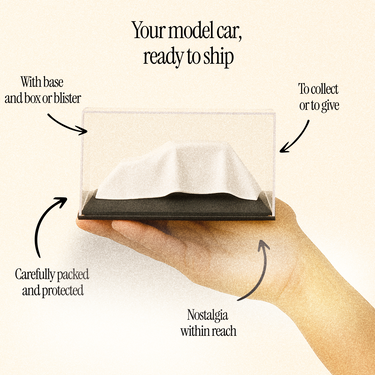
Yes, each model car is systematically delivered in its protective box. This box preserves the collectible value and protects your model car from dust and shocks.
How is my package protected during transport?
We package each order with the utmost care: bubble wrap, appropriate cushioning, and polystyrene. Your model car is perfectly secure during its journey.
What is the delivery time?
In-stock items are shipped within 24-48 hours. Please allow 2-3 business days for France via Colissimo or 4-5 days via Mondial Relay.
The model car is no longer in stock, when will you have it?
It's impossible for me to know exactly when I'll receive a new stock because I receive arrivals in dribs and drabs. Please contact me so I can keep you informed as soon as it's available.
What our customers say
Customer feedback and testimonials