


Le dernier exemplaire de cette miniature a ete vendu
Ces autres miniatures pourraient vous interesser
Même métier : publicitaire


Même marque : Citroën


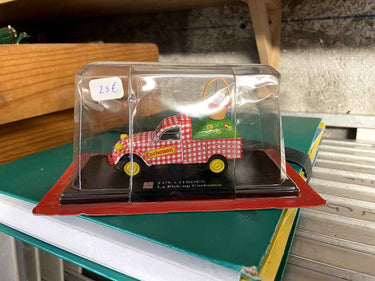


Model Car Citroën 2 CV pick-up Cochonou
Scale /43rd
slightly dented blister

Your payment information is processed securely.

An emblematic model car of French craftsmanship
This 1:43 scale Citroën 2CV Cochonou pickup perfectly embodies the resourceful and creative spirit of French artisans in the 1960s and 1970s. This exceptional model car captures the essence of a unique artisanal transformation, where the famous Deudeuche meets the world of traditional French charcuterie. A collector's item that bears witness to an era when popular ingenuity transformed vehicles according to the specific needs of the trades.
This remarkable piece is part of the lineage of converted French utility vehicles , representing a little-known but authentic facet of French automotive heritage. It will appeal to both collectors passionate about Citroëns and those fascinated by the history of traditional trades.
Characteristics of the model car
- Model: Citroën 2CV pick-up Cochonou
- Brand: Citroën
- Year: 1960s-1970s
- Scale: 1/43rd
- Color: Traditional Cochonou livery
- Protective case included: Yes
The 2CV pick-up: an iconic artisanal transformation
The Citroën 2CV pickup was not an official mass-produced version by Citroën, but was the result of artisanal transformations carried out by specialist coachbuilders. These conversions met the specific needs of craftsmen, tradespeople, and small businesses looking for an economical and practical vehicle for their professional activities.
The transformation involved cutting away the rear of the sedan to create an open bed, while keeping the front passenger compartment intact. This modification preserved the 2CV's intrinsic qualities: its robustness, mechanical simplicity, and ability to travel on all types of terrain. The result was a small, versatile utility vehicle perfectly suited to urban and rural deliveries.
These artisanal transformations are a testament to the French ingenuity of the time, when every trade found in the 2CV an ideal base for creating its own tailor-made work tool. The Cochonou version represents this perfect adaptation between a popular vehicle and the needs of a traditional charcuterie business.
Citroën in the 1960s and 1970s: innovation in everyday life
During this period, Citroën consolidated its reputation as an innovator with the 2CV, launched in 1948 but reaching its commercial peak in the following decades. The chevron brand then developed a unique philosophy: creating vehicles that met the real needs of users rather than the trends of the traditional automotive market.
The company unofficially encouraged these artisanal transformations, seeing them as proof of the versatility and adaptability of its vehicles. This pragmatic approach reflected Citroën's DNA: technical audacity serving practical solutions. The brand's tolerance for these modifications reflected an era when manufacturers maintained closer relationships with their users, accepting that their creations would evolve according to the specific needs of each profession.
The epic of Cochonou advertising vehicles
The story of this Cochonou 2CV pickup truck is part of the great tradition of French advertising vehicles that crisscrossed the roads of France. Cochonou, an iconic dry sausage brand founded in 1960, understood early on the importance of customer proximity. These small, converted utility vehicles traveled to markets, fairs, and local events, creating a direct link between the company and consumers.
The 2CV Cochonou pickup was much more than a simple delivery vehicle: it embodied the French art of living and the conviviality of village markets. Its driver, often dressed in a traditional blouse, distributed samples and told the story of his products, perpetuating a centuries-old commercial tradition. These vehicles contributed to the liveliness of city centers and the countryside, creating a daily spectacle enjoyed by all.
The originality of these artisanal transformations lay in their ability to personalize each vehicle according to the company's identity. The 2CV Cochonou proudly displayed the brand's colors and logo, transforming every trip into a communication campaign. This avant-garde marketing approach created a unique emotional connection between the brand and its customers, long before the advent of digital marketing.
These vehicles have influenced several generations of French people, creating indelible memories linked to regional flavors and culinary traditions. Now gone from the roads, these converted 2CV pickups remain etched in the collective memory as symbols of a bygone era when commerce retained a human face and every purchase was an encounter.
Complete your collection of French model cars
This Citroën 2CV Cochonou pick-up occupies a special place in the world of French car model cars . It perfectly complements a collection focused on advertising vehicles or Citroën 2CVs in their most original and authentic versions.
This piece harmonizes remarkably with other model cars representing French light commercial vehicles of the period, creating a coherent ensemble that tells the story of small trades and French craftsmanship. It also interacts with other French cars of its generation, offering a complete vision of the national automotive heritage.
This model car is aimed at collectors passionate about vintage vehicles , but also at lovers of French social and cultural history. It will naturally find its place alongside other commercial vehicles or in a collection dedicated to the 1960s and 70s , a prosperous period of social and economic transformation in France. An object of memory that perpetuates the memory of an era when popular ingenuity transformed everyday life.
Frequently Asked Questions
How to understand the scales of miniatures?
Scale indicates the reduction ratio between the real car and the miniature. For example, at 1:43 scale, each centimeter on the miniature corresponds to 43 centimeters on the real vehicle.
Concretely, a 1/18 scale Ferrari model is approximately 25-30 cm long, while in 1/43 scale it measures approximately 10 cm.
What scales are available?
Our model cars are mainly offered in 1/43, 1/24, 1/18 and 1/87 (HO) scales. The scale is always indicated in the product sheet.
The smaller the second number, the larger the model car (e.g. 1/18 is larger than 1/43).
Does the model car come with protection?
Yes, each model car is systematically delivered in its protective box. This box preserves the collectible value and protects your model car from dust and shocks.
How is my package protected during transport?
We package each order with the utmost care: bubble wrap, appropriate cushioning, and polystyrene. Your model car is perfectly secure during its journey.
What is the delivery time?
In-stock items are shipped within 24-48 hours. Please allow 2-3 business days for France via Colissimo or 4-5 days via Mondial Relay.
The model car is no longer in stock, when will you have it?
It's impossible for me to know exactly when I'll receive a new stock because I receive arrivals in dribs and drabs. Please contact me so I can keep you informed as soon as it's available.
What our customers say
Customer feedback and testimonials