


Le dernier exemplaire de cette miniature a ete vendu
Ces autres miniatures pourraient vous interesser
Même marque : Citroën


Même origine : française


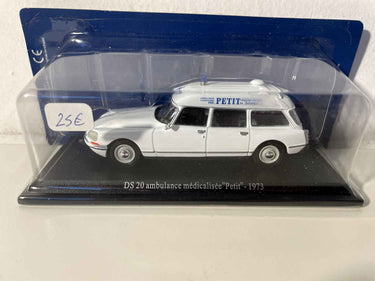


Model Car Citroën DS 20 "Petit" white medical ambulance from 1973
Scale: 1/43

Your payment information is processed securely.

Citroën DS 20 Medical Ambulance "Petit" 1973 - An Exceptional Diecast Model Car
This remarkable diecast model car of the Citroën DS 20 ambulance represents far more than a simple miniature replica. For collectors seeking authentic diecast model cars that capture the essence of French automotive innovation, this 1973 medicalized ambulance transformed by the renowned coachbuilder Petit stands as a testament to an extraordinary era. This die-cast collectible meticulously reproduces one of the most iconic emergency vehicles of the 1970s, a period when the DS dominated French roads and symbolized technological advancement at its finest.
This faithful reproduction appeals to enthusiasts of emergency vehicle model cars and collectors who appreciate the intricate details that define premium scale model vehicles. The level of craftsmanship evident in this 1/43 scale diecast car satisfies even the most discerning connoisseurs, making it an essential addition to any serious collection of French automotive miniatures.
Specifications of This Premium Diecast Model Car
- Model: DS 20 medical ambulance "Petit"
- Brand: Citroën
- Year: 1973
- Scale: 1/43
- Color: White with authentic ambulance markings
- Protective display case included: Yes
- Material: High-quality diecast metal construction
The Original Vehicle: A DS at the Service of Life
In 1973, the Citroën DS 20 ambulance represented the pinnacle of French mobile medical technology and automotive engineering excellence. Built upon the revolutionary DS 20 platform, this specialized ambulance version inherited all the groundbreaking advantages that made the standard saloon legendary: the revolutionary hydropneumatic suspension that delivered unparalleled comfort for patients during critical transport, exceptional road handling that inspired confidence in emergency situations, and the proven reliability that French emergency services demanded.
The bodywork transformation executed by specialists like Petit went far beyond cosmetic modifications. These expert coachbuilders completely redesigned the interior architecture to meet the exacting requirements of professional medical transport. The patient compartment featured optimized space utilization, with cutting-edge medical equipment for the era seamlessly integrated into the vehicle's design. The DS's legendary hydropneumatic suspension allowed emergency medical personnel to transport patients in unprecedented comfort, significantly reducing trauma related to vibrations and shocks during urgent journeys to hospitals.
This revolutionary suspension technology made the DS ambulance the preferred choice for emergency services throughout France and numerous international markets. The vehicle's versatility proved exceptional: capable of operating across all terrain types thanks to its variable ground clearance system, it performed equally well navigating tight urban streets and accessing rural areas with challenging road conditions. This adaptability made it an invaluable asset to emergency medical services during a transformative period in healthcare delivery.
Understanding the Diecast Model Car Collectible Market
The market for diecast model cars has experienced remarkable growth in recent years, with the global automotive diecast scale model market projected to reach significant milestones by 2030. Collectors and automotive enthusiasts increasingly recognize these miniature car replicas as both cherished collectibles and potential investments. The 1/43 scale segment, in particular, has maintained strong popularity among serious collectors who appreciate the perfect balance between display-friendly size and exceptional detail.
Premium die-cast collectibles like this Citroën DS ambulance occupy a special niche within the broader market. Emergency vehicles, classic French automobiles, and historically significant models command particular attention from collectors seeking pieces that tell compelling stories. The authenticity and craftsmanship evident in quality scale model cars ensure they retain value over time, making them worthwhile additions to carefully curated collections.
Citroën in 1973: The Golden Age of French Automotive Innovation
The year 1973 marked a fascinating chapter in Citroën's storied history. Under visionary leadership that began with founder André Citroën and continued through his successors, the chevron brand had firmly established itself as the symbol of French automotive innovation and technical excellence. The DS, launched nearly two decades earlier in 1955, continued revolutionizing the automotive industry with its avant-garde technical solutions, even as the company prepared to introduce the CX, which would eventually succeed the iconic DS line.
This period coincided with Citroën's ambitious international expansion strategy, with the company massively exporting its French cars and specialized derivatives such as ambulances to markets worldwide. The DS's unparalleled reputation for reliability, innovative engineering, and passenger comfort made it an obvious choice for professional fleets, particularly within the medical sector where safety, stability, and comfort were absolutely paramount.
French coachbuilders like Petit specialized in these sophisticated high-end conversions, transforming standard DS wagons into true functional works of art. These craftsmen possessed intimate knowledge of the DS's unique characteristics and leveraged this expertise to create purpose-built medical vehicles that maximized the platform's inherent advantages. The result was a fleet of ambulances that set new standards for patient care during transport.
The year 1973 also marked a pivotal period for the global automotive industry, with the first oil crisis disrupting established patterns and forcing consumers to reconsider their transportation choices. However, Citroën vehicles maintained their strong market position thanks to their relative fuel efficiency compared to larger vehicles and their renowned durability, which provided excellent long-term value for owners and fleet operators alike.
Why This Diecast Model Car Appeals to Serious Collectors
Several factors elevate this Citroën DS ambulance diecast model car above ordinary miniature replicas. First, the 1/43 scale represents the sweet spot for many serious collectors of scale model vehicles. This scale, where the model measures 1/43rd the size of the actual vehicle, provides sufficient size to showcase intricate details while remaining practical for display purposes. The scale has been popular among European collectors for decades and continues to dominate the premium die-cast collectible market.
Second, the subject matter itself holds considerable appeal. Emergency vehicles occupy a special place in automotive history, representing the practical application of automotive technology for humanitarian purposes. The DS ambulance, in particular, symbolizes a unique moment when cutting-edge automotive engineering directly contributed to improving emergency medical services. For collectors passionate about automotive heritage, this diecast model car represents a tangible connection to that important historical narrative.
Third, the quality of execution matters tremendously in the scale model car market. Premium manufacturers invest considerable resources in research, utilizing original documentation, photographs, and sometimes access to surviving vehicles to ensure their miniature car replicas achieve maximum authenticity. Details such as accurate color matching, proper proportions, authentic badging, and period-correct features distinguish exceptional diecast model cars from mass-market toys.
Living Legends: The DS Ambulance on French Roads
The story of DS ambulances intertwines inseparably with the modernization of French emergency medical services during the postwar decades. Throughout the 1970s, the sight of a white DS ambulance rushing along French routes nationales became deeply embedded in the national consciousness. These vehicles embodied the modernity of public services and provided reassurance to citizens with their imposing presence, distinctive lines, and advanced technology that seemed almost futuristic.
A compelling anecdote concerns the crucial role DS ambulances played during major sporting events of the era. These specialized vehicles were routinely deployed for motorsport competitions, most notably at the legendary 24 Hours of Le Mans, where their combination of high speed capability and exceptional comfort allowed rapid evacuation of injured drivers to nearby hospitals. Their ability to maintain significant velocity while preserving patient stability became legendary among medical personnel and racing officials alike.
The cultural impact of DS ambulances extended beyond their practical medical applications. Several prominent French films throughout the 1970s featured these distinctive white vehicles with their futuristic lines, helping anchor their image firmly in the collective imagination of an entire generation. The DS ambulance became a powerful symbol of the modern, efficient France that the nation sought to project during this period, joining other technological achievements like the Concorde supersonic airliner and, later, the TGV high-speed train as icons of French innovation.
Paramedics who operated DS ambulances often developed deeply personal relationships with their vehicles, mastering the nuances of the sophisticated hydropneumatic suspension system to optimize patient comfort during transport. This specialized technical expertise was carefully passed down from experienced professionals to new generations of emergency medical technicians, creating a distinct professional culture around these exceptional machines. Many retired paramedics from this era still speak fondly of their DS ambulances, recalling with pride how these vehicles enabled them to provide the highest standard of care during patient transport.
Building a World-Class Collection of Diecast Model Cars
For collectors seeking to build comprehensive, thematically coherent collections of diecast model cars, this Citroën DS ambulance serves as an ideal cornerstone piece. It integrates seamlessly into collections focused on emergency vehicles, providing historical context and visual interest alongside fire trucks, police vehicles, and other emergency service miniatures. The distinctive white livery and red cross markings ensure it stands out while complementing other emergency vehicle scale models.
This die-cast collectible also fits naturally within broader collections of iconic Citroën models. Enthusiasts who collect classic DS sedans, station wagons, convertibles, or commercial variants will find that adding this specialized ambulance version provides valuable insight into the DS's remarkable versatility and the many roles these vehicles filled in French society.
For collectors with particular passion for 1970s French automobiles, this piece serves as valuable testimony to an era when technical innovation operated in service of humanity. It can be thoughtfully integrated into larger displays depicting France during the Trente Glorieuses (the thirty prosperous years of postwar economic growth), positioned alongside other period vehicles, buildings, and figures to create immersive dioramas.
Enthusiasts of 1/43 scale model cars will particularly appreciate how this DS ambulance maintains scale consistency with other models in their collection. This compatibility enables the creation of cohesive displays where different vehicles can be arranged in realistic scenarios, whether depicting a city street scene, a rural village, or a motorsport venue. The visual impact of a carefully scaled collection far exceeds that of random assortments of mismatched miniatures.
The Art and Science of Diecast Model Car Manufacturing
Understanding the manufacturing process behind quality diecast model cars enhances appreciation for these miniature masterpieces. The term "diecast" refers to the metal casting process where molten metal (typically zinc alloy) is forced under high pressure into precisely machined steel molds called dies. This process enables the reproduction of fine details that would be impossible with other manufacturing methods, making it ideal for creating accurate scale model vehicles.
Premium manufacturers of die-cast collectibles invest heavily in research and development, beginning with detailed study of original vehicles through photographs, technical drawings, and access to museum examples or private collections. For a model like this DS ambulance, researchers would examine surviving vehicles, study period documentation from Citroën and coachbuilder Petit, and consult with automotive historians to ensure every detail achieves maximum authenticity.
The dies used to cast the main body components represent significant investments, often costing tens of thousands of euros to produce. These precision-machined molds must capture every subtle curve, character line, and surface detail of the original vehicle. For complex models, dozens of separate components may be cast individually before assembly, including the body, chassis, interior components, wheels, and glazing pieces.
After casting, skilled artisans carefully assemble each diecast model car, applying paint finishes, tampo-printed or water-slide decals for markings, and transparent components for windows and lights. Quality control remains paramount throughout production, with manufacturers inspecting each model to ensure it meets exacting standards before packaging. This meticulous attention to detail explains why premium scale model cars command higher prices than mass-market alternatives while delivering proportionally greater satisfaction to discriminating collectors.
Display and Preservation of Your Diecast Model Car Collection
Serious collectors understand that proper display and preservation techniques significantly impact the long-term condition and value of diecast model cars. This DS ambulance includes a protective display case, which provides essential protection against dust accumulation while allowing full visibility of the model's details. Display cases serve multiple purposes: they protect delicate components like mirrors and antennas from accidental damage, prevent dust from settling on the model's surface, and create an attractive presentation that enhances any collection.
When displaying die-cast collectibles, consider environmental factors carefully. Direct sunlight can fade paint finishes over time, particularly on white vehicles like this ambulance where discoloration becomes readily apparent. Temperature fluctuations and high humidity can affect both the metal components and any decals or printed details. Ideally, scale model vehicles should be displayed in climate-controlled environments away from direct sunlight, maintaining conditions similar to those recommended for fine art or valuable books.
For collectors building extensive displays of miniature car replicas, dedicated display cabinets with glass doors provide excellent protection while showcasing collections attractively. LED lighting systems designed for display cabinets illuminate models without generating heat that might damage finishes. Arranging models thematically—whether by manufacturer, era, vehicle type, or scale—creates visual cohesion and helps tell stories about automotive history and evolution.
Regular maintenance preserves the appearance and condition of diecast model cars. Gentle dusting with soft brushes removes accumulated particles without scratching painted surfaces. For models displayed outside protective cases, periodic careful cleaning with appropriate materials prevents buildup that can become difficult to remove over time. Handle models carefully, avoiding contact with painted surfaces and supporting the body rather than grasping delicate protruding elements like mirrors or antennas.
Investment Potential of Premium Diecast Model Cars
While most collectors acquire diecast model cars primarily for enjoyment and appreciation of automotive heritage, understanding market dynamics adds an interesting dimension to the hobby. The collectibles market for quality scale model vehicles has demonstrated consistent strength over decades, with certain models appreciating significantly in value, particularly limited editions, discontinued models from respected manufacturers, and pieces representing historically significant vehicles.
Several factors influence the investment potential of die-cast collectibles. Rarity plays a crucial role—models produced in limited quantities or for brief periods typically command premiums over mass-produced equivalents. Condition remains paramount, with mint condition pieces in original packaging fetching substantially higher prices than examples showing wear or damage. Provenance matters too; models from prestigious manufacturers known for quality and accuracy generally retain value better than budget alternatives.
The subject matter significantly affects desirability and long-term value. Models representing iconic vehicles, significant historical moments, or culturally important automobiles tend to appreciate more reliably than generic subjects. This DS ambulance possesses multiple desirable attributes: it represents an iconic French vehicle, depicts a specialized variant with limited production, and commemorates an important application of automotive technology. These characteristics suggest solid long-term collectibility.
Market trends in diecast model car collecting show increasing sophistication among buyers, with serious collectors willing to invest in premium pieces that offer exceptional detail, authenticity, and historical significance. Online marketplaces and auction platforms have expanded market reach, connecting buyers and sellers globally and increasing liquidity for quality pieces. This accessibility benefits both collectors seeking specific models and those eventually choosing to sell pieces from their collections.
The Historical Context: French Emergency Medical Services Evolution
To fully appreciate this diecast model car, understanding the evolution of French emergency medical services provides valuable context. Prior to the 1960s, ambulances were often little more than commercial vans hastily converted for patient transport, offering minimal comfort and rudimentary medical capabilities. The introduction of purpose-designed ambulances based on sophisticated platforms like the DS represented a quantum leap forward in emergency medical care.
The DS's advanced hydropneumatic suspension proved transformative for ambulance applications. Traditional vehicles with conventional spring suspension transmitted road irregularities directly to patients, potentially exacerbating injuries during transport. The DS's system, which used pressurized hydraulic fluid and nitrogen gas spheres instead of conventional springs, isolated the passenger compartment from road imperfections with remarkable effectiveness. This technology enabled significantly smoother rides, reducing patient trauma and improving outcomes.
French coachbuilders who specialized in ambulance conversions, including Petit, Currus, Carrier, and Heuliez, developed sophisticated techniques for adapting DS wagons to medical service. Modifications typically included raised rooflines to provide adequate headroom for medical personnel, specialized interior layouts optimizing space for patients and equipment, professional medical installations including oxygen systems and monitoring equipment, and distinctive white paint with red cross markings meeting emerging regulatory standards.
By the early 1970s, regulations increasingly standardized ambulance specifications in France, mandating white paint schemes with blue flashing lights. These regulations drove improvements in medical equipment integration and interior design. The coachbuilder Petit, based in Joué-lès-Tours, became particularly noted for innovations including distinctive roof raises that maintained the DS's characteristic lines while providing necessary interior space. Their designs influenced industry standards and set benchmarks other coachbuilders sought to match.
Citroën DS: Revolutionary Design That Defined an Era
No discussion of the DS ambulance would be complete without acknowledging the revolutionary nature of the DS platform itself. When Citroën unveiled the DS at the 1955 Paris Motor Show, it caused an immediate sensation. The car's futuristic styling, penned by Italian sculptor and designer Flaminio Bertoni, looked like nothing else on the road. Its aerodynamic form, distinctive front end with covered headlights, and graceful lines seemed to belong to a future decade rather than the conservative 1950s.
Beyond stunning aesthetics, the DS incorporated numerous technical innovations that remained advanced throughout its two-decade production run. The hydropneumatic suspension system that made it ideal for ambulance conversions also provided unmatched ride quality for standard applications, allowing the DS to glide over rough roads that punished conventional vehicles. The system's self-leveling capability maintained consistent ride height regardless of load, while variable ground clearance enabled the DS to navigate obstacles that would stop other cars.
The DS's hydraulic system extended beyond suspension, powering the brakes, clutch, and power steering through a network of pressurized fluid circuits. A high-pressure pump driven by the engine supplied the system, which operated at pressures far exceeding those in conventional vehicles. This central hydraulic system represented ambitious engineering that anticipated technologies that would become common decades later in luxury vehicles.
The DS's impact extended far beyond France, with the model earning recognition as one of the most influential automobile designs of the twentieth century. Design museums worldwide feature DS examples in their permanent collections, acknowledging its significance as both an aesthetic masterpiece and technical tour de force. For collectors of diecast model cars, owning quality DS replicas connects them to this rich automotive heritage.
Completing Your Emergency Vehicle Model Collection
For enthusiasts building specialized collections focused on emergency and public service vehicles, this Citroën DS ambulance diecast model car serves as an excellent foundation piece or valuable addition to existing displays. Emergency vehicle scale model cars offer fascinating glimpses into how different nations approached critical public services, with designs reflecting national automotive industries, cultural preferences, and regulatory requirements.
A comprehensive emergency vehicle collection might include various ambulance types from different eras and countries, allowing comparison of design approaches and technological evolution. Fire trucks from multiple nations demonstrate diverse solutions to firefighting challenges. Police vehicles show how law enforcement adapted civilian automobiles for specialized duty. Rescue vehicles including mountain rescue units, coast guard vessels, and air ambulances expand the collection's scope.
The 1/43 scale works particularly well for emergency vehicle collections because it allows display of larger vehicles like fire trucks alongside smaller ambulances and police cars at consistent scale. This consistency creates coherent dioramas where different emergency services can be shown responding to scenarios, whether urban incidents, rural emergencies, or major events requiring coordinated response.
Thematic display options abound for emergency vehicle diecast model cars. A chronological arrangement demonstrates technological progression over decades. Geographic groupings compare emergency services from different regions or countries. Type-based displays gather all ambulances, fire apparatus, or police vehicles together. Mixed scenarios show various emergency services collaborating, reflecting real-world emergency response operations.
Gift Considerations: Who Appreciates Diecast Model Cars?
This Citroën DS ambulance diecast model car makes an exceptional gift for multiple recipient types, each appreciating different aspects of this die-cast collectible. Understanding potential recipients helps givers select appropriate pieces and enhances appreciation for thoughtfully chosen gifts.
Healthcare professionals, particularly those working in emergency medical services, often deeply appreciate ambulance scale models that honor their profession's heritage. Retired paramedics who operated vehicles like the DS ambulance experience powerful nostalgia when encountering accurate replicas of equipment they used during their careers. Such gifts acknowledge their service while connecting them to important memories.
Francophiles and those with connections to France find special meaning in models representing iconic French vehicles. The DS occupies unique status in French culture, symbolizing postwar reconstruction, technological achievement, and national pride. For people passionate about French history, language, or culture, owning a quality DS diecast model car provides a tangible connection to France's automotive golden age.
Automotive historians and enthusiasts collecting significant vehicles from automotive history value models representing technological milestones or culturally important cars. The DS's revolutionary engineering and lasting influence on automotive design make it perpetually relevant to serious automotive scholars. Models like this ambulance variant add depth to collections by showing practical applications of innovative technology.
General collectors seeking quality pieces to anchor new collections or expand existing ones appreciate well-executed scale model vehicles like this DS ambulance. Its combination of historical significance, attractive presentation with included display case, and reasonable price point make it accessible to collectors at various experience levels while offering enough quality to satisfy experienced enthusiasts.
Frequently Asked Questions About Diecast Model Cars
What does 1/43 scale mean for diecast model cars?
The 1/43 scale indicates that the diecast model car measures 1/43rd the size of the actual vehicle. For example, if the real Citroën DS ambulance measured 4.8 meters long, the 1/43 scale model would be approximately 11 centimeters long. This scale has been popular in Europe for decades and offers an excellent balance between detail and display practicality. Models at this scale are large enough to showcase intricate features like accurate badging, detailed interiors, and authentic paint schemes, yet compact enough to allow collectors to build substantial collections without requiring excessive display space.
How should I clean and maintain my diecast model cars?
Maintaining diecast model cars requires gentle care to preserve finishes and details. Use soft brushes specifically designed for model cleaning to remove dust without scratching painted surfaces. For more thorough cleaning, slightly dampened microfiber cloths can wipe surfaces, but avoid excessive moisture that might damage decals or seep into joints. Never use household cleaning chemicals, which can damage paint or cause discoloration. Handle models by their chassis or sturdy body sections rather than delicate protruding parts. Store models in display cases or their original packaging to minimize dust accumulation and protect against accidental damage.
Are diecast model cars good investments?
While diecast model cars should primarily be collected for enjoyment, certain pieces do appreciate in value over time. Limited edition models from respected manufacturers, discontinued pieces representing significant vehicles, and models in mint condition with original packaging tend to perform best as investments. However, the collectibles market can be unpredictable, and appreciation is never guaranteed. Collectors should focus on acquiring pieces they genuinely appreciate rather than purchasing solely for potential financial returns. Quality models from established manufacturers representing historically significant vehicles like this DS ambulance generally retain value well and may appreciate modestly over time.
What makes premium diecast model cars worth higher prices?
Premium die-cast collectibles justify higher prices through superior research, materials, and manufacturing quality. Better models feature more accurate proportions derived from detailed study of original vehicles, finer detail in casting including sharper character lines and realistic surface textures, higher quality paint with even application and authentic color matching, more detailed interiors with accurately reproduced dashboards and seats, proper-scale photo-etched parts for grilles and trim, and better quality control ensuring consistency. Additionally, premium manufacturers often secure official licensing from automotive manufacturers, guaranteeing authenticity and supporting more thorough research.
Can I display diecast model cars in direct sunlight?
Direct sunlight should be avoided when displaying diecast model cars. Ultraviolet radiation gradually fades paint finishes, with white vehicles like this DS ambulance particularly susceptible to yellowing or discoloration. Extended sun exposure can also degrade decals, dry out rubber tires causing cracking, and potentially warp plastic components. If displaying near windows, use UV-filtering glass or position models away from direct light paths. LED lighting in display cabinets provides excellent illumination without the heat and UV radiation that harm models. Proper display techniques preserve condition and appearance for decades.
The Enduring Appeal of Classic French Automobiles
French automotive design occupies a distinctive position in automotive history, characterized by innovative engineering, distinctive styling, and willingness to pursue unconventional solutions. Beyond the DS, France produced numerous vehicles that challenged conventions and advanced automotive technology. This tradition of innovation makes French automobile diecast model cars particularly appealing to collectors who appreciate engineering creativity.
The postwar era represented France's automotive golden age, with manufacturers including Citroën, Peugeot, Renault, and smaller specialists producing remarkable vehicles. This period saw introduction of front-wheel drive when most manufacturers remained committed to traditional layouts, hydropneumatic suspension systems appearing years before competitors considered such technology, aerodynamic designs when many cars still featured upright, boxy profiles, and innovative safety features pioneering technologies later mandated by regulations.
Collectors passionate about French automotive heritage find diecast model cars representing these vehicles particularly rewarding. Each model tells stories about French engineering philosophy, design aesthetics, and the unique approaches French manufacturers took toward automotive challenges. Building a collection of French scale model vehicles creates a timeline of innovation spanning from postwar recovery through the industry's modern era.
This DS ambulance exemplifies the French approach: taking revolutionary technology initially developed for passenger cars and successfully adapting it for specialized professional applications. The DS's hydropneumatic suspension wasn't merely a luxury feature—it solved real problems in emergency medical transport, demonstrating how automotive innovation can improve human welfare. Such stories elevate die-cast collectibles from mere toys to meaningful artifacts preserving important technological and social history.
Why This Diecast Model Car Belongs in Your Collection
This model car Citroën DS ambulance represents an intersection of multiple collecting interests, making it appealing across different collector categories. For enthusiasts of emergency vehicles, it documents an important chapter in medical transport history. For admirers of iconic Citroën models, whether classic sedans, estates, or commercial variants, it demonstrates the DS platform's remarkable versatility.
Collectors passionate about 1970s French automobiles will find this piece provides valuable testimony to an era when technical innovation operated directly in service of humanitarian goals. The period's characteristic blend of advanced engineering with practical application created vehicles that genuinely improved lives—ambulances that reduced patient trauma, commercial vehicles that expanded business possibilities, and passenger cars that democratized comfort previously reserved for luxury vehicles.
The white livery and period-correct markings make this diecast model car visually striking in any display context. Whether positioned individually in its included display case, integrated into a broader emergency vehicle collection, or incorporated into elaborate dioramas depicting France during the Trente Glorieuses, it commands attention while contributing to larger narratives about automotive and social history.
For enthusiasts of 1/43 scale model cars, adding this DS ambulance ensures scale consistency across collections while providing a distinctive centerpiece that stands apart from more common sedan and coupe body styles. Its specialized nature and historical significance elevate it above typical passenger car models.
This die-cast collectible appeals equally to experienced collectors seeking rarified pieces to enhance established collections and newcomers building initial selections of quality scale model vehicles. Its combination of historical importance, attractive presentation, authentic details, and reasonable accessibility makes it an ideal choice regardless of collecting experience.
For those seeking meaningful gifts for healthcare professionals sensitive to their profession's heritage, this model recalls an era when French automotive innovation shone globally through achievements like this remarkable classic car from the 1970s. It honors the vital work of emergency medical personnel while celebrating the extraordinary vehicle that served their mission.
Ultimately, quality diecast model cars like this Citroën DS 20 ambulance transcend their status as mere collectibles, becoming tangible connections to automotive history, technological achievement, and human stories. They preserve memories of vehicles that shaped societies, influenced industries, and touched countless lives. For collectors who understand this deeper significance, each carefully selected scale model car represents not just a miniature vehicle, but a chapter in the ongoing story of human innovation and progress.
Frequently Asked Questions
How to understand the scales of miniatures?
Scale indicates the reduction ratio between the real car and the miniature. For example, at 1:43 scale, each centimeter on the miniature corresponds to 43 centimeters on the real vehicle.
Concretely, a 1/18 scale Ferrari model is approximately 25-30 cm long, while in 1/43 scale it measures approximately 10 cm.
What scales are available?
Our model cars are mainly offered in 1/43, 1/24, 1/18 and 1/87 (HO) scales. The scale is always indicated in the product sheet.
The smaller the second number, the larger the model car (e.g. 1/18 is larger than 1/43).
Does the model car come with protection?
Yes, each model car is systematically delivered in its protective box. This box preserves the collectible value and protects your model car from dust and shocks.
How is my package protected during transport?
We package each order with the utmost care: bubble wrap, appropriate cushioning, and polystyrene. Your model car is perfectly secure during its journey.
What is the delivery time?
In-stock items are shipped within 24-48 hours. Please allow 2-3 business days for France via Colissimo or 4-5 days via Mondial Relay.
The model car is no longer in stock, when will you have it?
It's impossible for me to know exactly when I'll receive a new stock because I receive arrivals in dribs and drabs. Please contact me so I can keep you informed as soon as it's available.
What our customers say
Customer feedback and testimonials