


Le dernier exemplaire de cette miniature a ete vendu
Ces autres miniatures pourraient vous interesser
Même métier : publicitaire


Même marque : Citroën


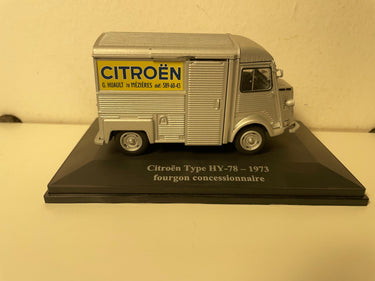


Model Car Citroën type HY-78 grey from 1973 - dealership van with Citroën logo
Citroën type HY-78 grey from 1973 - dealership van with Citroën logo
cardboard taped to the blister
Scale: 1/43

Your payment information is processed securely.

An emblematic model car of French utilitarian heritage
This 1973 Citroën Type HY-78 model car represents one of the most iconic vans in French motoring. Faithfully reproduced at 1/43 scale in its dealership gray livery with the authentic Citroën logo, this model is a choice piece for any collector passionate about the history of French commercial vehicles .
This meticulous replica captures the very essence of the Type HY, affectionately nicknamed "Tube" by its users, and is a must-have for model car collections dedicated to French automotive heritage.
Characteristics of the model car
- Model: Citroën Type HY-78
- Brand: Citroën
- Year: 1973
- Scale: 1/43rd
- Color: Dealership Gray
- Protective case included: Yes
The HY Type: light utility revolution
Launched in 1947, the Citroën Type H was born from the avant-garde vision of Pierre Boulanger, then head of Citroën. This revolutionary van was distinguished by its fully corrugated, self-supporting bodywork, a technical innovation that gave it exceptional strength while significantly reducing its weight. This bold design, inspired by the aeronautical techniques of the time, resulted in a vehicle that was both robust and economical to produce.
The 1973 HY-78 model represents one of the final evolutions of this legendary line. Equipped with the 1.9-liter 4-cylinder engine developing 62 horsepower, it benefits from the final improvements made to the range before production finally ceased in 1981. Its exceptional load capacity of more than one ton and its generous useful volume made it the preferred work tool of craftsmen, tradesmen and public services of the time.
With more than 473,000 units produced during its 34-year career, the Type H established itself as one of the most popular utility vehicles of the post-war period, profoundly marking the French economic and social landscape.
Citroën: innovation at the service of mobility
In the early 1970s, Citroën experienced a period of intense creativity under the leadership of André Citroën and his successors. The chevron brand distinguished itself through its revolutionary technical innovations : widespread front-wheel drive, hydropneumatic suspension, and avant-garde designs that challenged traditional aesthetic codes. This innovative philosophy is also reflected in its utility vehicle range, where the Type H perfectly embodies the brand's visionary spirit.
The year 1973 marked a special milestone in the history of Citroën, which had just completed its merger with Peugeot to form the PSA group. Despite these industrial upheavals, the brand continued to cultivate its unique technical identity and maintained production of the Type H, which had since become a symbol of French ingenuity. This pivotal period saw the birth of the latest versions of the famous van, witnesses to an era when technical audacity took precedence over purely commercial considerations.
The epic of the French "Tube"
The Citroën Type H owes its affectionate nickname "Tube" to its distinctive cylindrical silhouette, but also to its ubiquitous presence in the daily lives of the French. In the 1970s, this iconic van was used in all sectors of activity: from bakeries to breakdown services, including firefighters and the Post Office. Its unique profile became so familiar that it became an integral part of French urban and rural decor.
A delightful anecdote tells of how, during the filming of Jacques Tati's 1949 film "Jour de fête," the director deliberately chose a Type H to embody modernity over the traditional postman's bicycle. This now iconic sequence perfectly illustrates the "Tube"'s place in the French collective imagination: that of a symbol of progress and French efficiency .
Even more surprisingly, the Type H experienced an unexpected second youth in the 2000s with the rise of food trucks. Its easily modifiable bodywork and retro design seduced a new generation of entrepreneurs, transforming old work vans into trendy mobile restaurants . This contemporary revival proves the timeless relevance of Flaminio Bertoni and Pierre Boulanger's design.
Even today, seeing a restored Type H on the streets of France inevitably provokes smiles and nostalgia. This vehicle alone embodies thirty glorious years of French economic development, recalling an era when technical innovation rhymed with aesthetic audacity and when manufacturers dared to offer radically different solutions.
Complete your collection of French model cars
This model car of the Citroën Type HY-78 naturally finds its place at the heart of a collection dedicated to French automotive heritage . It harmonizes perfectly with other emblematic models of the chevron brand, notably the Citroën DS which simultaneously revolutionized the sedan segment, or the Citroën 2CV which democratized the French automobile.
Collectors specializing in light commercial vehicles will particularly appreciate this piece, which ideally complements a collection that includes iconic vans from the 1960s and 1970s. It also interacts with the Renault Estafette of the same era, offering a complete panorama of post-war French utility solutions.
This model car will appeal to both experienced collectors and automotive history enthusiasts who want to preserve the memory of these vehicles that shaped the economic face of France. It also provides an excellent entry point for discovering the world of French model cars , testifying to the ingenuity and audacity of French manufacturers during the decades of reconstruction and modernization of the country.
Frequently Asked Questions
How to understand the scales of miniatures?
Scale indicates the reduction ratio between the real car and the miniature. For example, at 1:43 scale, each centimeter on the miniature corresponds to 43 centimeters on the real vehicle.
Concretely, a 1/18 scale Ferrari model is approximately 25-30 cm long, while in 1/43 scale it measures approximately 10 cm.
What scales are available?
Our model cars are mainly offered in 1/43, 1/24, 1/18 and 1/87 (HO) scales. The scale is always indicated in the product sheet.
The smaller the second number, the larger the model car (e.g. 1/18 is larger than 1/43).
Does the model car come with protection?
Yes, each model car is systematically delivered in its protective box. This box preserves the collectible value and protects your model car from dust and shocks.
How is my package protected during transport?
We package each order with the utmost care: bubble wrap, appropriate cushioning, and polystyrene. Your model car is perfectly secure during its journey.
What is the delivery time?
In-stock items are shipped within 24-48 hours. Please allow 2-3 business days for France via Colissimo or 4-5 days via Mondial Relay.
The model car is no longer in stock, when will you have it?
It's impossible for me to know exactly when I'll receive a new stock because I receive arrivals in dribs and drabs. Please contact me so I can keep you informed as soon as it's available.
What our customers say
Customer feedback and testimonials