


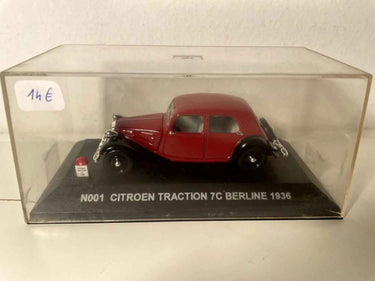


Model Car Citroën Traction 7C sedan burgundy/dark red from 1936 N001 (plexi box)
Scale 1/43
Tarnished and worn case
Case broken on one side

Your payment information is processed securely.
)

A miniature automotive legend
This burgundy 1936 Citroën Traction 7C saloon is a true treasure trove for collectors of model cars. Faithfully reproducing one of the most revolutionary cars in French automotive history, this 1:43 scale model captures the essence of this exceptional saloon that left a lasting mark on the 1930s.
Much more than a simple toy, this collectible miniature is a testament to Citroën's engineering genius and the technical audacity that characterized this pivotal era in the automotive industry. Its elegant burgundy/dark red color perfectly reflects the refinement of this sedan, which revolutionized the aesthetic codes of its time.
Characteristics of the miniature
- Model: Citroën Traction 7C sedan
- Brand: Citroën
- Year: 1936
- Scale: 1/43rd
- Color: Burgundy/dark red
- Protective case included: Yes
The revolutionary innovation of 1934
The Citroën Traction Avant was born in 1934 in a context of global economic crisis, driven by the bold vision of André Citroën and his design office headed by André Lefèbvre. This saloon literally revolutionized the automobile by abandoning the classic driveshaft transmission in favor of a new front-wheel drive . This technical innovation made it possible to considerably lower the vehicle's center of gravity and drastically improve its handling.
The 7C version, which inspired this miniature, is distinguished by its 1.3-liter four-cylinder engine developing 32 horsepower. Its monocoque body, another major innovation, gives the car unparalleled rigidity and safety for the time. The independent front suspension and precise steering make this sedan a true concentration of technology that still influences modern automotive design today.
The Traction's commercial success was immediate, despite its high price. Motorists discovered a car with exceptional road handling, capable of remarkable performance while offering revolutionary driving comfort. This sedan quickly became the emblem of French expertise in automotive innovation.
Citroën, pioneer of the popular automobile
In 1936, the year of the Traction 7C, Citroën was going through a crucial period in its history. Founded in 1919 by André Citroën, the chevron brand quickly established itself as one of the most innovative manufacturers in the world. After the success of the Type A in 1919, the first mass-produced European car, and then that of the 5 CV "Trèfle" in the 1920s, Citroën revolutionized the industry once again with the Traction.
This period marked the brand's creative peak, even though the colossal investments required to develop the Traction led André Citroën to sell his company to Michelin in 1935. Under this new management, Citroën continued its policy of innovation while stabilizing its financial situation. The Traction thus became the symbol of this successful transition, combining technical audacity and commercial viability .
The legacy of this era still influences Citroën's DNA today. This ability to innovate, challenge established conventions, and propose original technical solutions has its roots in the prosperous period of the 1930s, of which the Traction 7C is the most accomplished expression.
The automobile that conquered the Resistance
The history of the Citroën Traction extends far beyond the automotive sector and is deeply rooted in French history. During the Second World War, this sedan paradoxically became the benchmark vehicle for both the occupying forces and the French Resistance. Its robustness, reliability, and performance made it a particularly sought-after vehicle for critical missions.
Resistance fighters particularly appreciated its apparent discretion , which contrasted with its real capabilities. This bourgeois sedan could easily blend into the urban landscape while offering exceptional escape possibilities thanks to its road qualities. Many testimonies report the use of Tractions during clandestine operations, their road holding allowing them to lose potential pursuers on the winding roads of the time.
This reputation as a "gangster's car" also emerged in the 1930s and persisted well after the war. Criminals of the time adopted the Traction en masse for its escape qualities, contributing in spite of themselves to forging the legend of this exceptional automobile. This sulphurous image, far from harming its reputation, reinforced its status as a popular icon and fueled the French collective imagination.
Even today, the Traction evokes this troubled era when a simple sedan could change the course of history. This unique historical dimension gives each Traction miniature an emotional depth that goes far beyond a simple collector's item to become a true witness to French history.
Complete your collection of French model cars
This Citroën Traction 7C occupies a central place in the world of French car model cars. It is an essential item for any collector wishing to trace the evolution of the French automotive industry. Its presence in a collection immediately gives it a remarkable historical and technical dimension, testifying to the innovative capacity of French manufacturers.
To enrich your collection, this Traction harmonizes perfectly with other iconic models of French model cars . It naturally dialogues with Citroën model cars from other eras, creating a fascinating chronological coherence. Collectors passionate about cars from the 1930s will find in it a centerpiece that dialogues with Peugeot and Renault productions from the same period.
This miniature is aimed at both experienced collectors and automotive history enthusiasts. Its meticulous finish and historical authenticity make it an object of choice for lovers of miniature sedans and classic cars . It also constitutes an excellent introduction to 1/43rd scale model cars , allowing you to appreciate the level of detail and the quality of reproduction characteristic of this reference scale in the world of car modeling.
Frequently Asked Questions
How to understand the scales of miniatures?
Scale indicates the reduction ratio between the real car and the miniature. For example, at 1:43 scale, each centimeter on the miniature corresponds to 43 centimeters on the real vehicle.
Concretely, a 1/18 scale Ferrari model is approximately 25-30 cm long, while in 1/43 scale it measures approximately 10 cm.
What scales are available?
Our model cars are mainly offered in 1/43, 1/24, 1/18 and 1/87 (HO) scales. The scale is always indicated in the product sheet.
The smaller the second number, the larger the model car (e.g. 1/18 is larger than 1/43).
Does the model car come with protection?
Yes, each model car is systematically delivered in its protective box. This box preserves the collectible value and protects your model car from dust and shocks.
How is my package protected during transport?
We package each order with the utmost care: bubble wrap, appropriate cushioning, and polystyrene. Your model car is perfectly secure during its journey.
What is the delivery time?
In-stock items are shipped within 24-48 hours. Please allow 2-3 business days for France via Colissimo or 4-5 days via Mondial Relay.
The model car is no longer in stock, when will you have it?
It's impossible for me to know exactly when I'll receive a new stock because I receive arrivals in dribs and drabs. Please contact me so I can keep you informed as soon as it's available.
What our customers say
Customer feedback and testimonials