




)

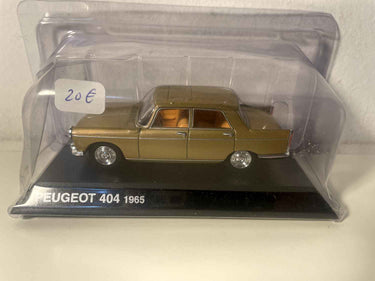
The Peugeot 404 in brown livery represents a remarkable diecast model car that celebrates one of the most iconic French automobiles of the 1960s. This exquisite miniature reproduction captures the essence of the original vehicle that became a global success story, selling nearly 2.9 million units worldwide between 1960 and 1989. For collectors seeking authentic representation of automotive history, this diecast model car offers an exceptional opportunity to own a piece of French engineering excellence in a perfectly scaled 1/43 format.
This faithful diecast model car reproduction showcases the timeless elegance of the legendary Peugeot 404, a model that profoundly marked the history of both Peugeot and the European automotive industry. The brown finish, particularly popular in African markets where the 404 earned its legendary reputation, adds historical authenticity to this collectible piece. Whether you're an automotive enthusiast, a dedicated collector of scale model vehicles, or simply appreciate the golden age of French automotive design, this diecast model car delivers exceptional detail and craftsmanship.
A true collector's item, this miniature car will delight both automobile aficionados and discerning collectors of die-cast replicas, offering a striking glimpse into the golden age of the French sedan and the remarkable story of a vehicle that conquered continents.
Characteristics of This Collectible Diecast Model Car
- Model: 404
- Brand: Peugeot
- Year: 1960-1975
- Scale: 1/43rd
- Color: Brown
- Protective case included: Yes
- Material: High-quality die-cast metal with detailed finishing
- Opening parts: Non-opening model (sealed for display)
Why Choose This Peugeot 404 Diecast Model Car
Among the vast selection of miniature vehicles available to collectors today, this Peugeot 404 diecast model car stands out for several compelling reasons. The 1/43 scale represents the perfect balance between detail and display convenience, making it an ideal choice for both seasoned collectors and those beginning their journey into scale model collecting. This particular scale has become the international standard for serious collectors, offering sufficient size to appreciate intricate details while remaining practical for display in cabinets or on shelves.
The brown color choice is historically significant and far from arbitrary. This rich, warm tone was exceptionally popular in markets where the 404 achieved legendary status, particularly across the African continent. From Dakar to Nairobi, brown 404s became synonymous with reliability and durability, often serving as taxis that accumulated astonishing mileage figures exceeding one million kilometers. This diecast model car therefore represents not just a vehicle, but a cultural icon that transformed transportation across multiple continents.
The inclusion of a protective display case elevates this diecast model car from a simple collectible to a museum-quality display piece. The case protects your investment from dust and handling damage while allowing full visibility of the model's exquisite details. For collectors who understand that proper preservation maintains and enhances value over time, this feature represents essential protection for what may become an increasingly valuable piece as vintage French car models continue to appreciate in collector markets.
Description of the Original Peugeot 404 Vehicle
To fully appreciate this diecast model car, understanding the remarkable history of the original Peugeot 404 is essential. Launched in April 1960 at the prestigious Paris Motor Show, the Peugeot 404 represented a major turning point in the history of the Sochaux-based manufacturer. Designed under the expert direction of the legendary Italian design house Pininfarina, this family sedan distinguished itself through elegant, modern lines that decisively broke with the aesthetic conventions of the era.
The collaboration between Peugeot and Pininfarina proved instrumental in the 404's success. Battista "Pinin" Farina, whose design house had already created automotive masterpieces for Ferrari, Maserati, and Alfa Romeo, brought sophisticated Italian styling to French engineering. The result was a vehicle that looked equally at home on Parisian boulevards and African dirt roads. The 404's design featured distinctive protruding fenders, a plunging bonnet, generous chrome grille, and curved windscreen that provided exceptional visibility—details faithfully reproduced in this diecast model car.
The 404 is characterized by its legendary robustness and unfailing reliability, qualities that made it one of the most respected vehicles of its generation. Equipped initially with a 1.6-liter engine developing 72 horsepower, it offered remarkable performance for the time while maintaining reasonable fuel consumption. Later versions featured fuel injection (a French first in 1962) and diesel options, expanding the model's appeal to diverse markets. Its independent front suspension with coil springs and rigid rear axle with leaf springs gave it exemplary road handling, capable of managing both smooth European highways and challenging terrain in developing nations.
With more than 2.8 million units produced over nearly three decades (including international production that continued until 1989), the Peugeot 404 enjoyed resounding commercial success. It established itself as one of the best-selling French sedans of its generation, consolidating Peugeot's international reputation and proving that French automotive engineering could compete globally. This production milestone makes the 404 one of the first French vehicles to achieve such widespread international success, a legacy now preserved in miniature form through quality diecast model cars like this brown 404.
History of the Peugeot Brand and the 404's Development
In the early 1960s, Peugeot underwent a period of intense modernization under the continued leadership of the founding family. The company, building on its centuries-old industrial heritage dating back to 1810, sought to establish itself firmly in the European automotive market in the face of growing competition, particularly from Citroën's revolutionary DS, unveiled in 1955.
The creation of the 404 was a direct response to this competitive challenge. When Citroën stunned the automotive world with the futuristic DS and its innovative hydraulic suspension, Peugeot executives realized they needed a compelling answer. Rather than attempting to match Citroën's technological complexity, Peugeot chose a different path: creating a vehicle that combined modern design with proven, reliable engineering. This philosophy would define the 404 and remains evident in every detail of this faithful diecast model car reproduction.
Founded in 1810 by Jean-Pierre and Jean-Frédéric Peugeot, the family business evolved from metallurgy to automobiles, including cycles and motorcycles. This gradual diversification demonstrates the lion brand's remarkable adaptability, with the company gradually becoming one of the pillars of the French automotive industry. The expertise acquired through decades of metalworking proved invaluable in the design of robust and durable vehicles like the 404, qualities that contributed to its success in demanding markets worldwide.
Peugeot's philosophy has always favored technical innovation combined with practical reliability and manufacturing quality—values which are fully embodied in the 404 and which contribute to forging the worldwide reputation of the Sochaux brand. This commitment to quality is reflected in modern collectibles like this diecast model car, which maintains the same attention to detail and craftsmanship that characterized the original vehicle.
The African Odyssey of the Peugeot 404
One of the most fascinating chapters in the history of the Peugeot 404 was written far from European roads, on the African continent. From the early 1960s, this French sedan conquered the markets of West, East, and North Africa, quickly becoming the symbol of automotive modernity and reliability in these regions. This African connection makes the brown diecast model car particularly significant, as it represents the color most associated with the 404's African success story.
In Senegal, Ivory Coast, Kenya, and Mali, the 404 established itself as the benchmark taxi thanks to its exceptional robustness and ability to tackle difficult roads with minimal maintenance. Dakar taxi drivers developed specific maintenance techniques that allowed some models to exceed a million kilometers—a testament to the vehicle's extraordinary durability. This remarkable longevity forged the legend of the "indestructible 404," and stories of these vehicles continue to inspire collectors who seek diecast model cars representing this legendary durability.
The 404's African reputation was further cemented through motorsport success. The vehicle achieved four outright victories in the grueling East African Safari Rally—widely considered the world's toughest automotive event—in 1963, 1966, 1967, and 1968. These victories over more powerful and exotic machinery earned the 404 the affectionate nickname "Simba" (Swahili for "lion") in Kenya, perfectly complementing Peugeot's lion emblem. For collectors of rally-heritage diecast model cars, the 404 represents an essential piece of motorsport history.
The brown color, particularly popular in the African market, became emblematic of this epic. It symbolizes the perfect adaptation of this European model to tropical and Sahelian conditions, demonstrating the relevance of Peugeot's technical choices. Today, 404s still circulate on African roads, testifying to the exceptional durability of this design—a legacy preserved through quality scale model reproductions.
This African success story contributes significantly to Peugeot's international influence and had a lasting influence on the brand's commercial strategy towards emerging markets, an approach that remains relevant in the group's contemporary strategy. For collectors, this historical context transforms a simple diecast model car into a tangible connection to a remarkable chapter of automotive and global history.
The 1/43 Scale: The Collector's Choice for Diecast Model Cars
The 1/43 scale has established itself as the international standard for serious diecast model car collectors, and for excellent reasons. This scale strikes an ideal balance between several critical factors that determine collectibility and display quality. At approximately 10 centimeters in length for a standard sedan, 1/43 scale models are large enough to showcase intricate details like dashboard instruments, grille patterns, and body contours, yet remain compact enough for practical display and storage.
Historically, the 1/43 scale gained prominence in Europe and has remained the preferred choice for manufacturers producing high-quality diecast model cars of classic and contemporary vehicles. Major brands like Minichamps, Spark, IXO, and Norev have built their reputations on 1/43 scale models, establishing quality standards that collectors now expect. This Peugeot 404 brown diecast model car meets these exacting standards, offering the detail and accuracy that discriminating collectors demand.
For collectors building comprehensive automotive collections, the 1/43 scale offers unparalleled advantages. The consistent scale allows for meaningful comparisons between different eras and marques, creating visually coherent displays that tell the story of automotive evolution. Whether displayed alongside contemporary French sedans like the Citroën DS or compared with international competitors from the same era, this 404 diecast model car maintains proper scale relationships that enhance any collection's educational and aesthetic value.
Complete Your Diecast Model Car Collection
This brown Peugeot 404 occupies a special place in the world of French miniature car collecting. It fits perfectly into collections dedicated to classics from 1950 to 1979, representing the golden age of family sedans when practical design met elegant styling. As a centerpiece or supporting player in a thematic display, this diecast model car provides both historical significance and visual appeal.
For enthusiasts building brand-specific collections, this model serves as an ideal complement to other models in the Peugeot range. From the earlier 203 and 403 to the later 504 and 505, the 404 represents a crucial link in Peugeot's evolution. Displaying multiple Peugeot models in chronological order allows collectors to trace the development of design philosophy and engineering approaches across decades, with each diecast model car telling part of a larger story.
Collectors passionate about French automotive heritage will appreciate pairing this 404 with French model cars from the same era, particularly the revolutionary Citroën DS or contemporary Renaults like the R8 and R16. Such combinations create fascinating narratives about the diverse approaches French manufacturers took during this innovative period, with each diecast model car representing different philosophies about what a family car should be.
This diecast model car also finds its natural place in thematic collections dedicated to iconic family sedans. The 404's combination of practical design, reliable engineering, and international success makes it an essential representative of the era when sedans dominated global automotive markets. Displayed alongside German, Italian, British, and American contemporaries, this Peugeot 404 demonstrates how French manufacturers carved out their distinctive identity in a competitive international marketplace.
Investment Potential of Classic French Diecast Model Cars
Beyond their aesthetic and historical appeal, quality diecast model cars like this Peugeot 404 represent potential investment opportunities for knowledgeable collectors. As original 404 vehicles become increasingly rare and valuable in the classic car market, well-preserved miniature replicas often appreciate alongside their full-size counterparts. Limited production runs, manufacturer discontinuations, and growing collector interest in 1960s French automobiles all contribute to potential value appreciation over time.
The brown color variant adds another dimension to collectibility. While common colors from mass production often have higher survival rates in both full-size vehicles and scale models, specific color variants that represent particular markets or historical contexts—like this African-market brown—can become particularly sought-after by specialized collectors. As interest in the 404's African legacy grows, diecast model cars in this distinctive finish may see increased demand.
Proper preservation remains crucial for maintaining and enhancing value. The included protective case provides essential protection against the primary threats to diecast model cars: dust accumulation, UV light exposure, and handling damage. Collectors should display these pieces away from direct sunlight, maintain stable temperature and humidity conditions, and handle them minimally to preserve both the model and its packaging in pristine condition.
Caring for Your Diecast Model Car Collection
Maintaining the condition and value of diecast model cars requires attention to several key factors. First, environmental control proves essential. Extreme temperature fluctuations can affect both the metal components and any plastic or rubber parts, potentially causing warping or discoloration. Humidity control matters equally, as excessive moisture can lead to oxidation of metal surfaces and deterioration of packaging materials.
Display location significantly impacts long-term preservation. Direct sunlight causes paint fading and plastic yellowing over time, so position your collection away from windows or use UV-filtering glass in display cases. Regular, gentle dusting with soft brushes designed for delicate collectibles prevents accumulation that can scratch paint surfaces. For diecast model cars with protective cases like this Peugeot 404, the case itself provides the first line of defense, but surrounding display conditions still matter.
Documentation enhances both enjoyment and value. Maintaining records of purchase date, source, price, and any unique characteristics or historical information creates provenance that future buyers value. Photographing your collection regularly documents its condition over time and provides insurance documentation if needed. For serious collectors, catalog systems—whether digital databases or traditional ledgers—transform a collection from a hobby into a properly curated archive.
The Broader Context: French Automotive Excellence in Miniature
This Peugeot 404 diecast model car represents more than just one vehicle—it embodies a critical period in French industrial history when French automotive manufacturers competed successfully on the global stage. The 1960s and 1970s witnessed French engineering excellence producing vehicles that combined innovative design, practical functionality, and distinctive character. From Citroën's hydropneumatic suspension to Renault's pioneering work with hatchback designs, French manufacturers consistently pushed boundaries.
The 404's success demonstrated that French vehicles could match and exceed international competitors in durability and reliability—qualities traditionally associated with German engineering. By proving themselves in the world's toughest conditions, from African deserts to South American mountains, Peugeots like the 404 established a reputation that continues to benefit the brand today. Collectors who acquire diecast model cars from this era aren't merely buying miniature vehicles; they're preserving tangible connections to this transformative period in automotive history.
Intended for Discerning Collectors and Automotive Enthusiasts
This faithful diecast model car reproduction will particularly appeal to 1/43 scale enthusiasts who seek authenticity and detail in their acquisitions. The model constitutes a precious testimony to French technical excellence of the 1960s, an era when European manufacturers defined modern automotive design and established quality standards that resonate today.
Whether you're building a comprehensive collection of French automotive heritage, focusing specifically on Peugeot's illustrious history, assembling a showcase of 1960s design excellence, or simply seeking a single exceptional piece that captures the spirit of a remarkable vehicle, this brown Peugeot 404 diecast model car deserves serious consideration. Its combination of historical significance, manufacturing quality, accurate scale reproduction, and cultural resonance makes it far more than just another miniature vehicle—it's a carefully crafted tribute to one of automotive history's most successful and beloved sedans.
The protective display case transforms this diecast model car from a collectible into a display-ready piece that looks impressive whether showcased individually or as part of a larger collection. For gift-givers seeking something special for the car enthusiast who appreciates quality, history, and craftsmanship, this model offers a thoughtful choice that will be treasured for years to come.
Conclusion: A Diecast Model Car That Tells a Story
In the world of scale model collecting, certain pieces transcend their status as mere reproductions to become storytellers, educators, and preservers of automotive heritage. This brown Peugeot 404 diecast model car achieves that distinction effortlessly. It reminds us that the most successful vehicles aren't always the fastest, the most luxurious, or the most technologically advanced—sometimes they're simply the most capable, reliable, and adaptable to the real-world challenges their owners face.
From Parisian streets to African plains, from European rallies to South American roads, the Peugeot 404 proved itself across continents and decades. This faithful miniature reproduction allows collectors and enthusiasts to celebrate that remarkable achievement, preserving in 1/43 scale the essence of a vehicle that changed perceptions about French automotive engineering and established standards for durability that few vehicles have matched. Add this exceptional diecast model car to your collection today and own a piece of automotive history that continues to inspire admiration more than six decades after its original introduction.
Frequently Asked Questions
How to understand the scales of miniatures?
Scale indicates the reduction ratio between the real car and the miniature. For example, at 1:43 scale, each centimeter on the miniature corresponds to 43 centimeters on the real vehicle.
Concretely, a 1/18 scale Ferrari model is approximately 25-30 cm long, while in 1/43 scale it measures approximately 10 cm.
What scales are available?
Our model cars are mainly offered in 1/43, 1/24, 1/18 and 1/87 (HO) scales. The scale is always indicated in the product sheet.
The smaller the second number, the larger the model car (e.g. 1/18 is larger than 1/43).
Does the model car come with protection?
Yes, each model car is systematically delivered in its protective box. This box preserves the collectible value and protects your model car from dust and shocks.
How is my package protected during transport?
We package each order with the utmost care: bubble wrap, appropriate cushioning, and polystyrene. Your model car is perfectly secure during its journey.
What is the delivery time?
In-stock items are shipped within 24-48 hours. Please allow 2-3 business days for France via Colissimo or 4-5 days via Mondial Relay.
The model car is no longer in stock, when will you have it?
It's impossible for me to know exactly when I'll receive a new stock because I receive arrivals in dribs and drabs. Please contact me so I can keep you informed as soon as it's available.
What our customers say
Customer feedback and testimonials