


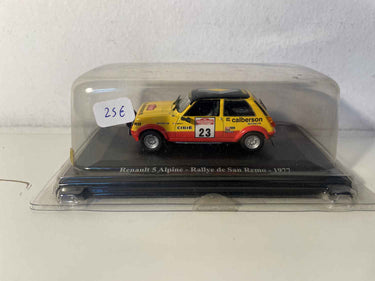


Model Car Renault 5 Alpine yellow, black and red number 23 - 1977 San Remo rally (blister)
Echelle: 1/43ème

Your payment information is processed securely.
)

Step into the thrilling world of 1970s motorsport with this exceptional diecast model car representing the legendary Renault 5 Alpine. This meticulously crafted miniature reproduces car number 23 from the iconic 1977 San Remo rally, featuring the striking yellow, black and red livery that defined French rallying's golden era. As a premium collectible diecast model car, this piece captures the very essence of the time when Renault transformed a humble city car into a formidable competition machine that dominated European rally stages.
Protected in its original blister packaging, this scale model car stands as an authentic testament to Renault's motorsport heritage. Whether you're an experienced collector of rally diecast models or discovering the passion for miniature racing cars, this Renault 5 Alpine represents a significant chapter in French automotive competition history. The attention to detail and historical accuracy make it a must-have addition for any enthusiast of die-cast collectibles.
Technical Specifications of This Diecast Model Car
- Model: Renault 5 Alpine San Remo rally
- Brand: Renault
- Year: 1977
- Scale: 1/43
- Color: Yellow, black and red
- Race number: 23
- Protective case included: Yes
- Condition: Mint in sealed blister
- Material: Die-cast metal with plastic details
The Renault 5 Alpine: Birth of a French Rally Legend
Launched in 1976, the Renault 5 Alpine emerged from Renault's ambitious vision to create a high-performance variant of its wildly popular R5 city car. This transformation marked a pivotal moment in automotive history, demonstrating how a practical urban vehicle could evolve into a genuine competition weapon. The engineers at Renault Sport completely reimagined the modest R5, installing a spirited 1.4-liter engine producing 93 horsepower—an impressive output that challenged conventional expectations for its class.
What distinguished this rally icon from its production counterpart were the unmistakable flared wheel arches and vibrant color schemes that became synonymous with French motorsport in the 1970s. The mechanical upgrades extended far beyond the engine bay: reinforced suspension components handled the punishing demands of rally stages, front disc brakes provided confident stopping power, and the famous lightweight alloy cylinder head contributed to the car's exceptional power-to-weight ratio. These engineering innovations transformed the R5 Alpine into one of the most exciting hot hatches of its era.
The market response was phenomenal. This accessible sports car democratized performance driving, offering a younger, dynamic clientele a credible alternative to traditional expensive sports cars at a fraction of the cost. The R5 Alpine's rally success quickly validated its engineering excellence, establishing it as a cornerstone of French motorsport heritage and making related miniature car models highly sought after by collectors today.
Renault Sport's Golden Era: Innovation and Competition
The year 1977 represented a period of creative effervescence for Renault under Bernard Hanon's visionary leadership. The French state-owned manufacturer pursued an aggressive strategy centered on technological innovation and cutting-edge design to expand its market presence globally. This philosophy materialized perfectly through the Alpine sports vehicle range, which Renault had strategically acquired in 1973, forever changing the company's sporting DNA.
The Alpine integration fundamentally transformed Renault's approach to performance vehicles. The technical expertise gained through competition programs—spanning Formula 1 to international rallying—directly influenced production model development. This symbiotic relationship between racing and road cars became the foundation of Renault Sport's identity, creating a distinguished lineage of high-performance vehicles that continues to inspire diecast model car collectors and automotive enthusiasts worldwide.
During this golden era, Renault invested heavily in motorsport development, understanding that competition success translated directly to showroom appeal. The lessons learned on rally stages—from suspension geometry to engine tuning—were rapidly implemented in production vehicles, establishing Renault as a serious player in the emerging hot hatch segment that would define 1980s automotive culture.
The Epic 1977 San Remo Rally: A Motorsport Milestone
The 1977 San Remo rally remains permanently etched in motorsport history as one of the most spectacular events of the World Rally Championship season. This prestigious Italian competition, renowned for its technically demanding special stages winding through the Ligurian hinterland, attracted Europe's finest teams and drivers. The event's challenging mountain roads and unpredictable Mediterranean weather conditions created the perfect proving ground for testing both driver skill and mechanical reliability.
The Renault 5 Alpine bearing number 23 perfectly embodies the French competitive spirit that characterized this heroic rallying period. Piloted by brave crews willing to push these nimble French machines to their absolute limits, the R5 Alpine demonstrated that innovative engineering and strategic preparation could challenge the established hierarchy. Italian spectators, captivated by the audacity and determination of these compact French rally cars, enthusiastically supported them throughout the grueling competition stages.
This participation aligned with Renault Sport's international development strategy, positioning each rally as a comprehensive real-world testing laboratory. The demanding conditions allowed engineers to continuously refine reliability and extract maximum performance from every component. Data meticulously collected during competitive events directly benefited production versions, creating an invaluable feedback loop between motorsport competition and customer vehicles—a philosophy that makes authentic rally diecast model cars from this era particularly valuable to collectors.
San Remo's unique atmosphere, characterized by stunning Mediterranean landscapes contrasting with challenging mountain passages, provided an ideal theatrical setting to showcase the R5 Alpine's sporting temperament. The combination of technical special stages, passionate Italian fans, and fierce international competition definitively confirmed the potential of Renault's compact performance car. This success paved the way for future victories in the European Rally Championship and directly influenced development of the legendary turbocharged R5 that would dominate Group B rallying in the 1980s.
Why Collect Diecast Model Cars from the Rally Era?
The appeal of rally car miniatures extends far beyond simple nostalgia. These precision-crafted scale models represent tangible connections to motorsport's most thrilling era, when Group 2 regulations allowed manufacturers to develop homologation specials that fans could actually purchase and drive. The 1970s rally scene produced some of the most visually distinctive and mechanically innovative competition cars ever created, making them enduringly popular subjects for die-cast collectibles.
For serious collectors, authenticity matters tremendously. High-quality diecast model cars like this Renault 5 Alpine reproduction feature accurate livery details, correct sponsor decals, proper wheel designs, and faithful color matching—elements that distinguish premium collectibles from basic toy replicas. The 1/43 scale has become the collector's standard for rally models, offering an ideal balance between displayable size and intricate detailing that captures the character of these competition machines.
The collectible value of vintage rally miniatures continues appreciating, particularly for limited production models representing historically significant vehicles. According to recent market analyses, the global diecast model car market is experiencing robust growth, with rally car replicas commanding premium prices among adult collectors who comprise approximately 60% of the market. Limited edition models from prestigious events like the San Remo rally frequently appreciate substantially, making them attractive both as passionate hobbies and alternative investment opportunities.
Investment Potential and Market Trends
The collectible miniature car market has matured significantly, with rare and historically significant models achieving impressive appreciation. Industry research indicates that limited-edition diecast rally cars from the 1970s golden era can appreciate between 15-30% annually when maintained in pristine, unopened condition. The combination of nostalgia-driven demand from baby boomer collectors, increasing recognition of motorsport heritage, and limited availability of authentic vintage models creates favorable conditions for value retention.
Modern manufacturing advances have elevated scale model car quality dramatically. Contemporary die-cast replicas feature working suspension components, opening doors and bonnets, detailed engine compartments, and even realistic rubber tires—refinements that enhance both display appeal and collector satisfaction. However, vintage models from the 1970s and 1980s often command premium prices due to their historical significance and relative scarcity in the secondary market.
Displaying and Preserving Your Diecast Model Cars
Proper care ensures your collectible miniatures maintain their value and appearance for decades. Environmental factors significantly impact die-cast models: direct sunlight causes paint fading and plastic component deterioration, while excessive humidity can promote corrosion on metal chassis and zamak components. Display your rally car models in climate-controlled environments away from windows and heat sources.
For serious collectors, protective display cases provide essential defense against dust accumulation and accidental damage. Acrylic display cabinets with UV-filtering properties offer museum-quality protection while showcasing your diecast model car collection beautifully. Many collectors organize their displays thematically—grouping rally cars by era, manufacturer, or specific competitions—creating visually compelling arrangements that tell the story of motorsport evolution.
Blister packaging, like the protective case included with this Renault 5 Alpine, serves dual purposes: it shields the model from environmental damage while confirming authenticity and maintaining mint condition status crucial for serious collectors. While some enthusiasts prefer removing models for photography or detailed examination, maintaining original packaging significantly enhances long-term collectible value, particularly for limited production runs and historically significant vehicles.
The Art of Rally Diecast Model Car Manufacturing
Creating authentic rally miniatures requires extraordinary attention to detail and specialized manufacturing expertise. The die-casting process begins with precision molds engineered to capture every contour, panel line, and aerodynamic element of the original competition vehicle. High-quality zinc alloys provide the structural foundation, offering excellent detail reproduction while maintaining durability that ensures these collectible models withstand careful handling and display.
Decoration represents perhaps the most critical phase distinguishing premium diecast model cars from basic reproductions. Authentic competition liveries from events like the 1977 San Remo rally feature intricate sponsor logos, racing numbers, and period-correct color schemes that must be precisely replicated. Pad printing and tampo printing technologies enable manufacturers to apply microscopic details with remarkable accuracy, recreating the visual impact of these iconic rally machines at 1/43 scale.
Contemporary manufacturers increasingly employ digital scanning technology, creating three-dimensional computer models from actual vehicles or archival photographs. This technological advancement ensures unprecedented accuracy in scale model car production, satisfying the exacting standards of knowledgeable collectors who compare miniatures against historical photographs and documentation. The result is a generation of die-cast collectibles that truly capture the essence and character of their full-size counterparts.
Complete Your Rally Miniature Collection
This Renault 5 Alpine from the San Remo rally occupies a choice position within the comprehensive universe of Renault miniatures. It serves as an ideal cornerstone for collections focused on rally vehicles from the 1970s golden era, when Group 2 and Group 4 regulations produced the most diverse and exciting field of competition cars in motorsport history.
Collectors passionate about French motorsport heritage will appreciate how this diecast model car complements other legendary models from the Alpine-Renault lineup. It harmoniously pairs with representations of the Alpine A110 Berlinette—the spiritual predecessor that dominated international rallying in the early 1970s—creating a cohesive narrative of French competition success. These 1/43 scale miniatures occupy minimal display space while offering maximum historical significance and visual impact.
This precision reproduction appeals equally to experienced collectors seeking to complete their rally car portfolios and newcomers discovering the compelling world of 1970s cars. Its exceptional historical authenticity and meticulous manufacturing quality position it as a privileged witness to motorsport evolution, perfectly complementing other French collectible cars curated by Bernard Miniatures for discerning enthusiasts.
Building a Thematic Rally Collection
Creating a focused rally car miniature collection offers numerous rewarding possibilities. Consider developing a chronological display showcasing rally evolution through different regulatory eras—from Group 2's production-based competitors through Group 4's homologation specials to Group B's unrestricted monsters. Alternatively, assemble manufacturer-specific collections celebrating marques like Renault, Lancia, or Ford that dominated specific periods of international competition.
Event-focused collections represent another compelling approach. Gathering diecast model cars from prestigious rallies like Monte Carlo, San Remo, RAC Rally, or Tour de Corse creates fascinating historical documentation of these legendary competitions. Each model becomes part of a larger narrative, illustrating how teams adapted their strategies, liveries, and technical approaches to conquer diverse competitive challenges across Europe's most demanding rally stages.
Frequently Asked Questions About Rally Diecast Model Cars
What makes 1/43 scale ideal for rally model collections?
The 1/43 scale strikes an optimal balance for diecast model car collectors, offering sufficient size for appreciating intricate details while remaining space-efficient for comprehensive collections. This scale has become the international standard for rally miniatures, ensuring consistent proportions when displaying multiple vehicles together. Manufacturers can include remarkable details at 1/43—from accurate suspension components to precisely replicated liveries—that would be impossible at smaller scales yet more affordable than larger 1/18 representations.
How can I verify the authenticity of vintage rally models?
Authenticating collectible diecast models requires examining several key indicators. Original packaging displays manufacturer logos, correct model identification, and period-appropriate graphics. The model itself should feature manufacturer markings on the chassis, typically including brand name, scale, and production country. Compare paint application, decal quality, and detail accuracy against reference photographs or manufacturer catalogs. Reputable sellers provide provenance documentation, and collector communities offer invaluable expertise for identifying reproductions or counterfeit models.
What preservation methods protect diecast models long-term?
Optimal preservation of rally miniatures begins with environmental control. Store and display your scale model cars in stable conditions: moderate temperatures (18-22°C), low humidity (40-50% relative humidity), and away from direct sunlight that accelerates paint degradation. For mint-condition preservation, maintain original blister packaging. Displayed models benefit from enclosed cabinets protecting against dust and accidental contact. Handle models minimally, and when necessary, wear cotton gloves preventing skin oils from affecting metal and painted surfaces.
Are limited edition rally models better investments?
Limited production diecast model cars typically appreciate more reliably than standard catalog releases due to artificial scarcity and higher initial quality standards. However, investment potential depends on multiple factors: historical significance of the subject vehicle, manufacturer reputation, production quantity, and overall market demand for specific rally eras or marques. Models commemorating championship-winning vehicles, milestone events, or featuring particularly detailed craftsmanship command strongest secondary market premiums. Research comparable sales and consult specialized collector price guides before making investment-focused acquisitions.
Should I remove models from blister packaging?
This represents a fundamental collector dilemma. Maintaining original blister packaging preserves maximum collectible value and provides superior protection against environmental damage and handling wear. For investment-focused collectors or those pursuing museum-quality preservation, unopened packaging is essential. However, many enthusiasts prefer displaying rally diecast models outside packaging to fully appreciate manufacturing details and create more dynamic arrangements. Consider your primary collecting motivation—pure enjoyment versus future resale value—when making this irreversible decision.
The Cultural Impact of Rally Racing and Its Miniatures
Rally racing's influence extended far beyond motorsport during the 1970s, permeating popular culture through cinema, television coverage, and automotive enthusiasm. The diecast model car industry capitalized on this cultural phenomenon, producing thousands of different rally car replicas that allowed fans to celebrate their heroes and favorite competitions. Manufacturers like Solido, Corgi, Dinky Toys, and later specialized producers created miniatures that became treasured possessions for generations of enthusiasts.
These collectible miniatures served multiple cultural functions: they introduced young people to automotive diversity and mechanical appreciation, provided affordable access to exotic competition machines, and documented motorsport history through tangible three-dimensional artifacts. Unlike photographs or video footage, scale model cars offered interactive engagement—they could be handled, studied from every angle, and integrated into imaginative play or sophisticated displays.
The resurgence of interest in vintage rally car models reflects broader nostalgia for 1970s automotive culture—a period remembered for distinctive styling, mechanical simplicity, and driver-focused engineering before electronic systems dominated vehicle dynamics. Modern collectors appreciate how these miniatures preserve memories of an unrepeatable era when rallying represented the pinnacle of automotive adventure and engineering innovation accessible to private competitors and factory teams alike.
Technical Evolution: From Group 2 to Group B
Understanding the regulatory evolution illuminating rally history enhances appreciation for period diecast models. The 1977 San Remo rally occurred during Group 2's dominance—regulations requiring production-based vehicles with limited modifications. This meant the Renault 5 Alpine competing in this event retained close mechanical relationships to cars customers could purchase from dealerships, making rally success particularly relevant for showroom credibility.
Group 2 regulations mandated minimum production quantities, restricting engine modifications while permitting suspension, brake, and aerodynamic improvements. This framework produced incredibly diverse competition fields featuring everything from small-displacement hot hatches like the R5 Alpine to large-displacement muscle sedans, creating visually spectacular and mechanically varied rally grids that translate beautifully into collectible model car displays representing multiple manufacturers and vehicle philosophies.
The subsequent evolution toward Group B's unlimited regulations during the early 1980s transformed rally cars into purpose-built competition machines bearing only superficial resemblance to production counterparts. This progression makes Group 2-era rally miniatures particularly significant for collectors appreciating the final chapter of production-based international competition before technological arms races created the fire-breathing turbocharged monsters that ultimately proved too dangerous for continuation.
Conclusion: Celebrating Motorsport Heritage Through Diecast Models
This Renault 5 Alpine diecast model car representing the 1977 San Remo rally transcends its status as mere miniature replica—it embodies a significant chapter in French motorsport history, commemorating an era when engineering innovation, driver courage, and mechanical reliability combined to create unforgettable competitive spectacles on Europe's most challenging roads. For collectors of rally car miniatures, such models provide tangible connections to automotive heritage that photographs and videos cannot replicate.
The combination of historical authenticity, manufacturing quality, and cultural significance positions this scale model car as an essential acquisition for enthusiasts passionate about 1970s rallying, Renault's motorsport legacy, or French automotive achievement. Whether displayed individually as a focal point or integrated within comprehensive diecast model car collections, this Renault 5 Alpine serves as a permanent tribute to the golden age of rally competition.
As the collectible miniature car market continues expanding globally, driven by adult collectors seeking nostalgic connections and investment opportunities, authentic representations of historically significant competition vehicles appreciate steadily in both monetary and cultural value. Add this exceptional piece to your collection and preserve an important fragment of motorsport history—a miniature monument to French engineering excellence and rally racing's most exciting era.
Frequently Asked Questions
How to understand the scales of miniatures?
Scale indicates the reduction ratio between the real car and the miniature. For example, at 1:43 scale, each centimeter on the miniature corresponds to 43 centimeters on the real vehicle.
Concretely, a 1/18 scale Ferrari model is approximately 25-30 cm long, while in 1/43 scale it measures approximately 10 cm.
What scales are available?
Our model cars are mainly offered in 1/43, 1/24, 1/18 and 1/87 (HO) scales. The scale is always indicated in the product sheet.
The smaller the second number, the larger the model car (e.g. 1/18 is larger than 1/43).
Does the model car come with protection?
Yes, each model car is systematically delivered in its protective box. This box preserves the collectible value and protects your model car from dust and shocks.
How is my package protected during transport?
We package each order with the utmost care: bubble wrap, appropriate cushioning, and polystyrene. Your model car is perfectly secure during its journey.
What is the delivery time?
In-stock items are shipped within 24-48 hours. Please allow 2-3 business days for France via Colissimo or 4-5 days via Mondial Relay.
The model car is no longer in stock, when will you have it?
It's impossible for me to know exactly when I'll receive a new stock because I receive arrivals in dribs and drabs. Please contact me so I can keep you informed as soon as it's available.
What our customers say
Customer feedback and testimonials