


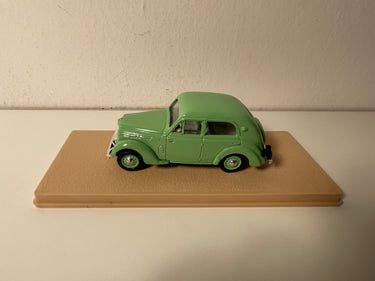


Model Car 1938 Green Renault Juvaquatre Sedan - ELIGOR
Echelle: 1/43ème

Your payment information is processed securely.


Chargement de vos recommandations...
Discover this 1938 Green Renault Juvaquatre Sedan, an ELIGOR miniature that faithfully captures the essence of this revolutionary 1930s automobile. This meticulous reproduction showcases French ingenuity and the evolution of the automotive industry on the eve of World War II.
This collectible miniature represents a major turning point in Renault's history, marking the entry of the diamond brand into the era of automotive democratization with a model that was accessible and modern for its time.
Miniature Features
- Model: Juvaquatre Sedan
- Brand: Renault
- Year: 1938
- Scale: 1/43
- Color: Green
- Manufacturer: ELIGOR
- Protective case included: Yes
The Real Model: A Technical Revolution
The Renault Juvaquatre was unveiled at the Paris Motor Show in October 1937, marking a significant stylistic and technical break for the brand. This model embodied Louis Renault's desire to offer a modern, economical automobile accessible to the greatest number, in the difficult economic context of the 1930s.
Technically revolutionary, the Juvaquatre abandoned the traditional separate chassis in favor of a monocoque construction, a first for Renault. Its four-cylinder engine of 1003 cm³ developed 23 horsepower, enabling a top speed of 85 km/h. This four-door sedan was distinguished by its modern lines, characteristic grille, and headlights integrated into the fenders.
The commercial success was immediate despite the troubled context of the time. The Juvaquatre perfectly met the expectations of a middle-class clientele in search of modernity and reliability, quickly establishing itself as a reference in the market for affordable family cars.
Renault in 1938: Innovation in the Service of Progress
In 1938, Renault was undergoing a profound transformation under Louis Renault's leadership. Established in 1898, the company had positioned itself as one of the most innovative French car manufacturers, particularly recognized for its technical prowess and adaptability to market changes.
The creation of the Juvaquatre was part of the automotive democratization strategy initiated by the diamond brand. Faced with the growing competition from Citroën with its revolutionary Traction Avant from 1934, Renault needed to provide a compelling technical and commercial response. The company mobilized its engineering teams to design a vehicle combining modern construction and price accessibility, positioning the Juvaquatre as the spearhead of its popular range.
The Epic of the "Little Renault" During the War
The story of the Juvaquatre takes on a special dimension with the outbreak of World War II. Starting in 1940, civilian production was interrupted, but the model would experience an unexpected second life. The German authorities, recognizing the vehicle's qualities, permitted limited production for essential services and administration.
During the Occupation, the Juvaquatre paradoxically became a symbol of passive resistance. Many units were converted into gas generators to cope with fuel shortages, these artisanal modifications showcasing French ingenuity in the face of restrictions. Some vehicles even served as communication links for the Resistance, their plain appearance providing perfect camouflage.
The most striking anecdote concerns the fate of several Juvaquatre vehicles requisitioned by the Wehrmacht. Ironically, these French vehicles found themselves in the service of the occupiers, but their legendary reliability quickly made them favorites among German officers. This involuntary recognition of French quality did not escape the observers of the time.
After Liberation, the Juvaquatre resumed its civilian career with renewed success. The French, deprived of cars for four years, flocked to this tried-and-true model, contributing to the revival of the French automotive industry and the development of the Renault collection.
Complete Your Miniature Collection
This Renault Juvaquatre ELIGOR naturally finds its place in any collection dedicated to classic cars or 1930s automobiles. Its meticulous finish and 1/43 scale make it an ideal complement to other models from the interwar period, particularly the French cars of this pivotal era.
Collectors passionate about automotive history will particularly appreciate this miniature alongside other iconic models like the Citroën Traction Avant or the Peugeots of the time. This Juvaquatre also serves as an excellent starting point for a thematic collection on the evolution of French family sedans, showcasing the technical ingenuity and know-how of our national manufacturers across decades.
Frequently Asked Questions
How to understand the scales of miniatures?
Scale indicates the reduction ratio between the real car and the miniature. For example, at 1:43 scale, each centimeter on the miniature corresponds to 43 centimeters on the real vehicle.
Concretely, a 1/18 scale Ferrari model is approximately 25-30 cm long, while in 1/43 scale it measures approximately 10 cm.
What scales are available?
Our model cars are mainly offered in 1/43, 1/24, 1/18 and 1/87 (HO) scales. The scale is always indicated in the product sheet.
The smaller the second number, the larger the model car (e.g. 1/18 is larger than 1/43).
Does the model car come with protection?
Yes, each model car is systematically delivered in its protective box. This box preserves the collectible value and protects your model car from dust and shocks.
How is my package protected during transport?
We package each order with the utmost care: bubble wrap, appropriate cushioning, and polystyrene. Your model car is perfectly secure during its journey.
What is the delivery time?
In-stock items are shipped within 24-48 hours. Please allow 2-3 business days for France via Colissimo or 4-5 days via Mondial Relay.
The model car is no longer in stock, when will you have it?
It's impossible for me to know exactly when I'll receive a new stock because I receive arrivals in dribs and drabs. Please contact me so I can keep you informed as soon as it's available.
What our customers say
Customer feedback and testimonials