


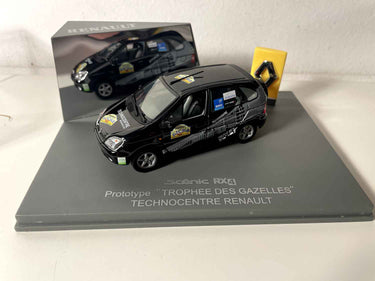


Model Car Renault Scénic RX4 prototype TROPHEE DES GAZELLES (Technocentre Renault) WITH the cardboard box - Universal Hobbies
Echelle: 1/43ème
Boitier fissuré sur une longueur de 10 cm environ sur le dessus

Your payment information is processed securely.

Chargement de vos recommandations...
This exceptional diecast model car of the Renault Scénic RX4 prototype in the distinctive livery of the prestigious Trophée des Gazelles represents a remarkable achievement in French automotive innovation and miniature craftsmanship. Developed by the renowned Technocentre Renault, this extraordinary vehicle perfectly embodies the diamond brand's pioneering spirit in exploring new territories, both geographical and technological, while this meticulously detailed replica captures every essence of that adventurous journey.
Reproduced with exceptional precision by Universal Hobbies, this collectible diecast model car immortalizes the adventurous spirit of this unique prototype that made its mark during the famous women's rally across the unforgiving Moroccan desert. Beyond being a simple miniature vehicle, this piece stands as a testament to French automotive engineering excellence and represents an essential addition for enthusiasts of French automobiles, off-road adventures, and high-quality scale model collecting. The attention to detail in this reproduction makes it a centerpiece that celebrates both automotive history and the art of miniature model making.
Technical Specifications and Features of This Diecast Model Car
- Model: Scénic RX4 prototype Trophée des Gazelles
- Brand: Renault
- Year represented: 2000s
- Scale: 1/43 - Perfect for collectors seeking detailed miniature replicas
- Manufacturer: Universal Hobbies - Renowned for precision die-cast collectibles
- Livery: Authentic Trophée des Gazelles racing decoration
- Protective case included: Yes - Ensures optimal preservation of your collectible
- Material: High-quality diecast metal construction with refined details
- Condition: Comes with original cardboard packaging for enhanced collectibility
The Scénic RX4 Prototype: Renault's Bold Off-Road Innovation
The Renault Scénic RX4 emerged from an audacious vision to transform the revolutionary compact minivan concept into a capable off-road explorer. Conceived in the early 2000s during a period of intense creative experimentation, this prototype represented an innovative marriage between the practicality that defined the traditional Scénic and the rugged capabilities demanded by adventure vehicles. The Technocentre Renault, serving as the brand's innovation laboratory and creative hub, engineered this exceptional version as both a technological demonstrator and a statement of automotive possibility.
Engineers equipped this remarkable vehicle with an advanced all-wheel-drive system and significantly increased ground clearance, transforming its capabilities entirely. The RX4 incorporated comprehensive underbody protection plates and dramatically widened fender extensions specifically designed to accommodate aggressive off-road tires. This radical metamorphosis of the peaceful family-oriented minivan into a desert-conquering adventurer demonstrated Renault's exceptional capability for innovation and its determination to explore untapped market segments. The prototype featured reinforced suspension components, specialized shock absorbers, and modified chassis reinforcements that allowed it to tackle terrain that would challenge traditional SUVs.
Although the Scénic RX4 remained in prototype status and never reached mass production, its influence rippled throughout Renault's subsequent product development strategy. This groundbreaking concept directly inspired numerous developments in the brand's expanding SUV and crossover range, effectively anticipating the market's dramatic evolution towards versatile elevated vehicles. Today, collectors recognize this diecast model car as representing a pivotal moment in automotive design thinking, when manufacturers began seriously exploring the fusion of practicality with adventure capability.
Renault's Heritage of Automotive Innovation and Excellence
During the era when the Scénic RX4 prototype captured imaginations, Renault was experiencing an extraordinary period of creative dynamism that would define the brand's direction for decades to come. The French manufacturer, riding high on the tremendous commercial triumph of the original Scénic launched in 1996, actively explored bold variations to extend the influence of its revolutionary minivan concept. This golden age of innovation at Renault was characterized by daring concepts, forward-thinking product development, and a willingness to challenge conventional automotive wisdom.
Founded in 1898 by the visionary brothers Louis, Marcel, and Fernand Renault, the diamond brand has consistently distinguished itself through pioneering achievements and technical breakthroughs throughout its storied history. From its humble beginnings in Billancourt, where the first Renault vehicles rolled off modest production lines, the company revolutionized the automotive industry with groundbreaking innovations including the direct transmission gearbox and the widespread popularization of front-wheel drive architecture. Over the following decades, the French company continually reinvented itself, achieving victories in prestigious Grand Prix races during the 1900s and introducing technological revolutions that reshaped the automotive landscape, such as the spacious Espace minivan and the paradigm-shifting Scénic compact MPV.
The history of Renault remains inextricably intertwined with that of French industrial prowess and automotive excellence. Nationalized following World War II to support France's reconstruction efforts, then privatized during the transformative 1990s before entering into the strategic Alliance with Nissan, the brand has never ceased to innovate, surprise, and redefine expectations within the global automotive marketplace. This rich heritage makes every Renault die-cast model car not just a miniature replica, but a tangible connection to over a century of automotive achievement.
The Trophée des Gazelles: An Extraordinary Testing Laboratory for Innovation
The Trophée des Gazelles represents far more than a conventional automotive competition—it functions as an intensive endurance laboratory where manufacturers rigorously test their latest innovations under the planet's most demanding conditions. Established in 1990 by French adventurer Dominique Serra, this unique all-female rally raid unfolds annually across the spectacular yet unforgiving Moroccan desert, traversing the dramatic landscapes between Erfoud and Merzouga. This challenging environment provides an incomparable natural testing ground where every component, system, and material choice faces extreme validation that no traditional test track could replicate.
The participation of the Scénic RX4 prototype in this legendary desert adventure formed part of an ambitious technological validation program that would inform Renault's future product development. The towering Sahara dunes and endless sandy expanses create a merciless natural testing environment where each automotive component endures extraordinary constraints: scorching daytime temperatures exceeding 50°C, abrasive sand particles that infiltrate every seal and bearing, complex navigation challenges requiring precise instrumentation, and particularly demanding driving conditions that test both vehicle durability and driver endurance. For Renault's engineering teams, this represented an invaluable opportunity to demonstrate that the family-friendly DNA of the Scénic platform could successfully adapt to the most audacious automotive challenges imaginable.
This intensive desert experience enabled Technocentre engineers to gather invaluable performance data on all-wheel-drive system behavior under extreme load, material resistance to harsh Saharan environmental conditions, cooling system efficiency in extreme heat, and the ergonomics of specialized navigation equipment in challenging rally conditions. The comprehensive insights gained from this desert adventure directly influenced the development trajectory of future generations of Renault crossover vehicles, contributing substantially to the evolution of French engineering expertise in the expanding SUV and adventure vehicle marketplace. Knowledge about dust ingestion protection, thermal management in extreme conditions, and drivetrain durability proved immediately applicable to production vehicle programs.
Renault's strategic commitment to the Trophée des Gazelles perfectly illustrated the brand's enduring philosophy: constantly pushing technological boundaries, fearlessly exploring new territories both literal and metaphorical, and demonstrating that French automotive innovation could not only survive but excel in the planet's most hostile and challenging environments. This spirit of adventure and technical excellence is precisely what makes this diecast model car such a meaningful collectible for enthusiasts who appreciate automotive courage and engineering achievement.
Understanding Diecast Model Car Collecting and Scale Model Appreciation
The world of diecast model cars represents a fascinating intersection of automotive passion, historical preservation, and artistic craftsmanship that has captivated collectors worldwide for generations. These precision-engineered miniature replicas transcend their humble origins as children's toys to become sophisticated collectibles that document automotive history, celebrate engineering achievements, and preserve automotive culture in exquisite detail. The 1/43 scale, exemplified by this Universal Hobbies Renault Scénic RX4, occupies a special position in the collecting hierarchy—offering remarkable detail while maintaining practical display dimensions that allow collectors to build comprehensive collections without requiring excessive space.
Modern die-cast collectibles benefit from advanced manufacturing techniques including computer-aided design, precision molding processes, and sophisticated painting technologies that achieve unprecedented levels of realism and accuracy. Manufacturers like Universal Hobbies invest considerable resources in researching original vehicles, studying period photographs, and consulting technical documentation to ensure their miniature replicas faithfully reproduce every significant detail of the full-size originals. From accurately rendered dashboard instruments to precisely scaled suspension components, contemporary scale models represent remarkable achievements in miniaturization and craftsmanship.
Collectors appreciate these miniature car models for multiple compelling reasons beyond simple nostalgia. Each piece serves as a three-dimensional historical document, preserving the styling, proportions, and character of vehicles that may no longer exist or remain accessible only to wealthy collectors of full-size automobiles. Limited production prototypes like the Scénic RX4, which never reached mass production, become especially significant—their diecast representations may be the only way most enthusiasts can examine and appreciate these rare automotive experiments. Additionally, the investment potential of carefully selected collectible models has attracted sophisticated collectors who recognize that rare, well-preserved pieces from respected manufacturers can appreciate significantly over time.
Building and Expanding Your French Automotive Miniature Collection
This meticulously detailed reproduction of the Scénic RX4 prototype occupies a particularly special position within the universe of French automotive miniatures and represents a unique moment in Renault's evolutionary history, capturing a time when the brand boldly explored radical new directions for its flagship model lines. Collectors with discerning taste will particularly appreciate the exceptional rarity of this model, which serves as a fascinating witness to an era when innovation and experimental thinking prevailed over conservative commercial caution. The combination of prototype status, rally participation history, and limited production makes this piece especially desirable for serious collectors.
To thoughtfully enrich and diversify your collection of scale model vehicles, this distinctive piece beautifully complements other iconic models representing the best of French automotive production across different eras and categories. It naturally harmonizes with other celebrated Renault creations in your growing collection, particularly civilian versions of various Scénic generations that show the model's evolution, or the adventurous off-road vehicles from other manufacturers that share the RX4's exploratory spirit. Enthusiasts passionate about concept cars and experimental prototypes will discover an ideal complement to their existing acquisitions, as this piece represents that rare category of vehicles that challenge conventional thinking.
This exceptional Universal Hobbies miniature replica will particularly resonate with collectors passionate about French automobile heritage, automotive adventure and rally enthusiasts who appreciate vehicles with competition pedigree, and those interested in automotive innovations from the 2000s era. It also serves as an excellent foundation for developing a thematic collection centered around exceptional promotional vehicles and significant French automotive prototypes that pushed technological boundaries. The presence of the original cardboard packaging adds additional collectible value and authenticity to this remarkable piece.
Why Diecast Model Cars Remain Timeless Collectibles
The enduring appeal of automotive scale models transcends generational boundaries and continues attracting new enthusiasts even as collecting trends evolve. Several fundamental factors explain why these miniature marvels maintain their cultural relevance and collector interest across decades. First, they offer accessibility to automotive excellence—allowing enthusiasts to own representations of vehicles that might be financially unattainable, extraordinarily rare, or no longer in existence. A collector of modest means can assemble a museum-quality collection of die-cast replicas representing the world's most significant automobiles, from vintage classics to contemporary supercars, without requiring the massive financial resources necessary for acquiring the actual vehicles.
Second, these miniature vehicles serve vital educational and historical preservation functions that extend beyond simple collecting pleasure. Museums, automotive historians, and educational institutions increasingly recognize quality diecast models as valuable teaching tools and historical references. They allow detailed study of design evolution, technological progression, and styling trends across automotive history in ways that photographs or drawings cannot fully capture. The three-dimensional nature of these models reveals proportions, spatial relationships, and design details that two-dimensional representations fail to convey adequately.
Third, the craftsmanship and artistry involved in creating premium collectible miniature cars elevates them beyond mere toys into the realm of decorative art. Contemporary manufacturers employ talented designers, skilled painters, and precision toolmakers who approach their work with the dedication of fine craftspeople. Limited edition releases, particularly those commemorating significant racing victories, historical milestones, or experimental prototypes like this Scénic RX4, become increasingly valuable as time passes and original production quantities dwindle. Serious collectors recognize that carefully selected pieces represent not only automotive history but also investment opportunities that can appreciate substantially over time.
The Universal Hobbies Legacy in Diecast Manufacturing Excellence
Universal Hobbies has established itself as a distinguished manufacturer within the competitive diecast model car marketplace, earning respect from collectors worldwide for consistent quality, historical accuracy, and attention to authentic detail. Founded with a commitment to producing affordable yet meticulously crafted miniatures, the company has developed particular expertise in reproducing French automotive subjects, agricultural machinery, and commercial vehicles that other manufacturers often overlook. This focus on representing everyday vehicles and working machines, alongside more glamorous subjects, has created a distinctive product portfolio that appeals to collectors seeking diversity beyond exotic sports cars and racing machines.
The company's manufacturing process combines traditional diecast metalworking techniques with modern precision tooling and quality control procedures. Each model begins with extensive research, including studying original technical documentation, examining surviving examples when possible, and consulting period photographs to ensure historical accuracy. This research phase proves especially crucial when reproducing limited production prototypes like the Scénic RX4, where reference materials may be scarce and surviving examples rare or non-existent. Universal Hobbies' commitment to getting details correct—from livery graphics to wheel designs—distinguishes their products in a marketplace where attention to authenticity separates premium collectibles from basic toys.
For collectors, Universal Hobbies models offer excellent value propositions, delivering impressive detail and build quality at accessible price points that allow enthusiasts to build substantial collections without prohibitive expense. The inclusion of protective display cases with models demonstrates the company's understanding that collectors require proper storage and presentation solutions. This Scénic RX4 reproduction exemplifies Universal Hobbies' strengths: representing an interesting subject with historical significance, executed with careful attention to accuracy, and presented in collector-friendly packaging that protects the investment while allowing attractive display.
Caring for Your Diecast Model Car Collection
Preserving the condition and value of your scale model collection requires understanding proper handling, storage, and display techniques that protect these delicate miniatures from environmental damage and physical harm. While diecast models feature robust metal construction, their painted finishes, small fragile parts, and decorative details remain vulnerable to various threats including dust accumulation, sunlight exposure, temperature fluctuations, and improper handling. Implementing thoughtful care practices ensures your collection maintains its aesthetic appeal and monetary value for decades.
Display location significantly impacts long-term preservation. Position your collectible models away from direct sunlight, which causes paint fading and plastic component deterioration over time. Ultraviolet radiation proves particularly destructive to vibrant colors and clear plastic parts, gradually bleaching finishes and causing brittleness. Similarly, avoid placement near heating vents, radiators, or air conditioning outlets where temperature variations and airflow deposit dust and create expansion-contraction cycles that stress delicate components. Stable, moderate temperature environments with controlled humidity levels provide optimal preservation conditions.
Regular gentle cleaning maintains appearance while preventing permanent damage from accumulated contaminants. Use soft, lint-free cloths or specialized model dusting brushes to remove surface dust, avoiding abrasive materials that might scratch painted surfaces. For stubborn dirt, slightly dampened cloths work effectively, but ensure complete drying before returning models to display cases or storage. Never use household chemical cleaners, which may react with paints, plastics, or adhesives used in model construction. When handling models, grasp substantial body sections rather than fragile protruding elements like mirrors, antennas, or thin suspension components. The original protective case included with this Scénic RX4 model provides excellent storage when the piece isn't displayed, protecting against dust while allowing visibility.
Frequently Asked Questions About Collecting Diecast Model Cars
What makes 1/43 scale the ideal choice for collectors?
The 1/43 scale represents an optimal balance between manageable size and visible detail, making it the most popular scale among serious diecast model car collectors worldwide. Models at this scale typically measure 9-12 centimeters in length, allowing collectors to build substantial collections without requiring excessive display space. Manufacturers can incorporate impressive detail levels at 1/43 scale, including accurate interior features, undercarriage components, and engine bay details that remain visible without magnification. Additionally, the 1/43 scale enjoys the broadest selection of subjects across all automotive categories, from vintage classics to modern exotics, ensuring collectors can find models representing virtually any vehicle of interest.
How should I assess the quality and authenticity of a diecast model?
Evaluating collectible miniature cars requires examining several quality indicators that distinguish premium pieces from basic toys. First, inspect paint application for evenness, proper color matching to original vehicles, and clean separation between different color areas without overspray or bleeding. Second, examine printing quality of graphics, badges, and livery details—sharp, clear reproduction indicates quality tooling and production standards. Third, assess proportional accuracy by comparing the model's overall shape and dimensions to photographs of the actual vehicle; reputable manufacturers invest heavily in accurate scaling and proportions. Fourth, check mechanical features like opening parts, which should operate smoothly with appropriate resistance, neither too loose nor requiring excessive force. Finally, research the manufacturer's reputation—established names like Universal Hobbies, Minichamps, and AutoArt consistently deliver superior quality compared to anonymous budget producers.
Will this diecast model car appreciate in value over time?
Several factors influence potential appreciation of scale model collectibles, making some pieces more likely to increase in value than others. Limited production prototypes like this Scénic RX4 generally show better appreciation potential than mass-produced civilian vehicles, as their rarity and historical significance appeal to dedicated collectors. Condition remains paramount—models maintained in mint condition with original packaging appreciate far more reliably than played-with or damaged pieces. Manufacturer reputation matters significantly; respected brands with quality reputations like Universal Hobbies maintain value better than unknown manufacturers. Market trends also play roles; French automotive subjects enjoy strong European demand, while certain themes like rally vehicles, racing cars, and unusual prototypes attract passionate collector followings willing to pay premium prices. While not guaranteed investments, carefully selected die-cast models maintained in excellent condition can appreciate substantially, particularly rare subjects from quality manufacturers.
What other models complement the Scénic RX4 in a collection?
Building a thematically coherent collection enhances both enjoyment and potential value. This Scénic RX4 pairs naturally with other Renault models representing the brand's evolution, particularly other Scénic variants and contemporary Renault concepts. Rally and competition vehicles form another logical pairing—consider adding other Trophée des Gazelles participants, Paris-Dakar competitors, or off-road capable vehicles that share the RX4's adventurous spirit. Collectors interested in automotive prototypes and concept vehicles might group this piece with other experimental designs that never reached production, creating a fascinating display of "what might have been." Finally, 2000s-era innovations represent another coherent theme, showcasing the automotive industry's transition into the new millennium.
How can I verify this model's authenticity and production details?
Authentic Universal Hobbies models feature several identifying characteristics that confirm genuine production. Check the model's base for clearly molded or printed manufacturer markings, including the Universal Hobbies name, scale information, and often production country details. Original packaging should display Universal Hobbies branding with professional graphics, proper language translations, and barcode information—counterfeit products typically show poor quality printing and generic packaging. The protective case included with this model should fit precisely and display appropriate quality materials rather than cheap substitutes. Documentation or paperwork accompanying the model may include authenticity certificates or product information sheets bearing official Universal Hobbies branding. When purchasing from reputable dealers specializing in diecast model cars, authenticity concerns diminish significantly, as established retailers maintain reputations by selling only legitimate products from authorized distribution channels.
Investing in Automotive History Through Scale Model Collecting
This exceptional diecast model car representing the Renault Scénic RX4 prototype transcends its status as a simple miniature toy to become a meaningful piece of automotive history preserved in 1/43 scale. It captures a bold experimental moment when French engineers dared to reimagine a practical family vehicle as a desert-conquering adventurer, documenting that innovative spirit in permanent form. For collectors passionate about French automotive achievement, rally raid heritage, or prototype vehicles that challenged conventional thinking, this Universal Hobbies reproduction offers both immediate aesthetic pleasure and long-term collectible value.
Whether you're establishing a new collection focused on French automobiles, expanding an existing assemblage of miniature vehicles, or seeking that perfect centerpiece representing automotive courage and innovation, this Scénic RX4 model delivers on multiple levels. Its combination of historical significance, quality manufacture, authentic detail, and included original packaging positions it as a standout acquisition that will provide lasting satisfaction while potentially appreciating as a collectible investment. Add this remarkable piece to your collection today and own a tangible connection to Renault's adventurous exploration of the boundaries between practicality and possibility.
Même compétition : rallye


Même métier : commercial


%20WITH%20the%20cardboard%20box%20-%20Universal%20Hobbies)
Frequently Asked Questions
How to understand the scales of miniatures?
Scale indicates the reduction ratio between the real car and the miniature. For example, at 1:43 scale, each centimeter on the miniature corresponds to 43 centimeters on the real vehicle.
Concretely, a 1/18 scale Ferrari model is approximately 25-30 cm long, while in 1/43 scale it measures approximately 10 cm.
What scales are available?
Our model cars are mainly offered in 1/43, 1/24, 1/18 and 1/87 (HO) scales. The scale is always indicated in the product sheet.
The smaller the second number, the larger the model car (e.g. 1/18 is larger than 1/43).
Does the model car come with protection?
Yes, each model car is systematically delivered in its protective box. This box preserves the collectible value and protects your model car from dust and shocks.
How is my package protected during transport?
We package each order with the utmost care: bubble wrap, appropriate cushioning, and polystyrene. Your model car is perfectly secure during its journey.
What is the delivery time?
In-stock items are shipped within 24-48 hours. Please allow 2-3 business days for France via Colissimo or 4-5 days via Mondial Relay.
The model car is no longer in stock, when will you have it?
It's impossible for me to know exactly when I'll receive a new stock because I receive arrivals in dribs and drabs. Please contact me so I can keep you informed as soon as it's available.
What our customers say
Customer feedback and testimonials