




)
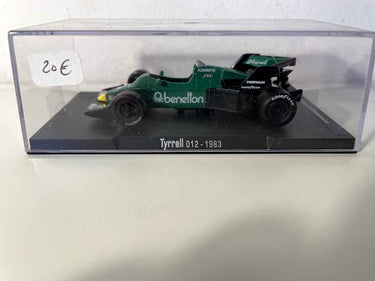
Tyrrell 012 number 3 - Formula 1 1983
This model car Tyrrell 012 number 3 in its iconic green livery from the 1983 season is an authentic testament to the golden age of Formula 1. Reproduced in 1:43 scale with remarkable attention to detail, this collector's item perfectly captures the essence of this British single-seater that marked the history of motorsport.
A true collector's item for Formula 1 and automobile enthusiasts, this model car is aimed at both seasoned collectors and amateurs wishing to own a piece of the history of the world championship.
Characteristics of the model car
- Model: Tyrrell 012
- Brand: Tyrrell
- Year: 1983
- Scale: 1/43rd
- Color: Green
- Number: 3
- Protective case included: Yes
The Tyrrell 012: a transitional single-seater
The Tyrrell 012 was developed for the 1983 season in a particularly challenging environment for the British team. Faced with the rise of turbocharged engines that increasingly dominated the field, Ken Tyrrell and his team attempted to maintain their competitiveness with a naturally aspirated Ford Cosworth engine, faithful to their philosophy of simplicity and efficiency.
This single-seater represented a significant evolution over its predecessors, with a redesigned chassis to optimize aerodynamics and compensate for the power deficit compared to turbocharged cars. The 012 displayed the clean lines characteristic of the Tyrrell style, with its tapered body and distinctive rear wing giving it an instantly recognizable silhouette on the racetrack.
Despite its undeniable qualities in terms of road holding and reliability, the Tyrrell 012 suffered from the power handicap inherent to naturally aspirated engines, which limited its performance against turbocharged competition from McLaren, Ferrari or Renault.
Tyrrell Racing: British independence in Formula 1
Tyrrell Racing was founded in 1968 by Ken Tyrrell , a former driver turned visionary team principal. The British outfit quickly established itself as one of the major forces in Formula 1, thanks in part to its successful collaboration with Jackie Stewart, who helped the team win three consecutive World Drivers' Championships between 1969 and 1973.
In the early 1980s, when the 012 was being designed, Tyrrell was going through a delicate transition phase. The team, which had shone during the 1970s with drivers like François Cevert and Jody Scheckter, now had to deal with the technological evolution of the championship and the massive arrival of turbo engines. Ken Tyrrell, fiercely attached to his independence, refused partnerships with major manufacturers and continued to develop his single-seaters according to his own vision of motor racing.
This family-run, craft-driven team philosophy made Tyrrell a unique player on the grid, representing the original spirit of Formula 1 in the face of the sport's growing professionalization.
The Tyrrell 012 Anecdote: The Last Breath of the Atmospheric
The 1983 season marked a turning point in the history of Formula 1, with the near-absolute dominance of turbocharged engines . In this context, the Tyrrell 012 paradoxically embodied both the past and a certain form of technological resistance. Ken Tyrrell, convinced that naturally aspirated engines retained advantages in terms of reliability and fuel consumption, hoped that the regulations would limit the advantage of turbos.
One of the most memorable anecdotes from this period concerns the bold strategy adopted by Tyrrell during the 1983 Detroit Grand Prix . Aware that his 012 could not compete in terms of pure speed, Ken Tyrrell focused everything on reliability and race management. While several turbocharged single-seaters were retiring one after the other, victims of overheating or reliability problems linked to the complexity of their mechanics, the Tyrrell 012 finished in the points, temporarily validating its designer's philosophy.
This symbolic performance perfectly illustrated the dilemma of Formula 1 at the time : should it prioritize raw power over reliability, or maintain a more measured approach? The 012 represented the latter school of thought, even if history ultimately proved the turbo proponents right.
Ironically, this resistance to technological innovation that characterized Tyrrell at this time prefigured current debates about the increasing complexity of modern Formula 1, making the 012 a particularly relevant historical testimony for understanding the evolution of motorsport.
Complete your model car collection
This model car Tyrrell 012 naturally finds its place at the heart of a collection dedicated to the history of Formula 1. It harmonizes perfectly with other emblematic models of the 1980s , a fascinating period of technological changes in the world championship.
Passionate Formula 1 collectors will particularly appreciate the complementarity of this Tyrrell with other single-seaters of the era, notably the turbocharged Ferraris and McLarens that dominated the circuits at the time. This diversity helps recreate the unique atmosphere of the starting grids of the 1980s.
Beyond motorsport enthusiasts, this model car will also appeal to collectors drawn to racing cars and British automotive history. Its meticulous workmanship and historical authenticity make it a lasting investment for any enthusiast looking to enrich their collection with reference pieces. Those nostalgic for classic cars will also find it a valuable testament to the technological evolution of motorsport.
Frequently Asked Questions
How to understand the scales of miniatures?
Scale indicates the reduction ratio between the real car and the miniature. For example, at 1:43 scale, each centimeter on the miniature corresponds to 43 centimeters on the real vehicle.
Concretely, a 1/18 scale Ferrari model is approximately 25-30 cm long, while in 1/43 scale it measures approximately 10 cm.
What scales are available?
Our model cars are mainly offered in 1/43, 1/24, 1/18 and 1/87 (HO) scales. The scale is always indicated in the product sheet.
The smaller the second number, the larger the model car (e.g. 1/18 is larger than 1/43).
Does the model car come with protection?
Yes, each model car is systematically delivered in its protective box. This box preserves the collectible value and protects your model car from dust and shocks.
How is my package protected during transport?
We package each order with the utmost care: bubble wrap, appropriate cushioning, and polystyrene. Your model car is perfectly secure during its journey.
What is the delivery time?
In-stock items are shipped within 24-48 hours. Please allow 2-3 business days for France via Colissimo or 4-5 days via Mondial Relay.
The model car is no longer in stock, when will you have it?
It's impossible for me to know exactly when I'll receive a new stock because I receive arrivals in dribs and drabs. Please contact me so I can keep you informed as soon as it's available.
What our customers say
Customer feedback and testimonials