


Le dernier exemplaire de cette miniature a ete vendu
Ces autres miniatures pourraient vous interesser
Même marque : Bernard Miniatures


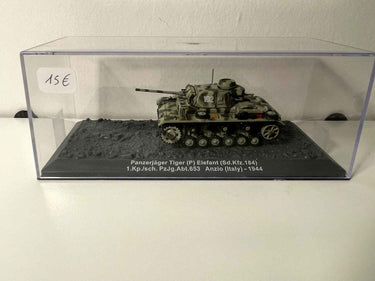


Model Car Military Vehicle - Panzerjäger Tiger (P) Elefant (Sd.Kfz.184) 1.Kp./sch. PzJg.Abt.653 Anzio (Italy) - 1944
Echelle: ?
Véhicule en plastique

Your payment information is processed securely.
%20Elefant%20(Sd.Kfz.184)%201.Kp./sch.%20PzJg.Abt.653%20Anzio%20(Italy)%20-%201944)
Discover this faithful replica of the Panzerjäger Tiger (P) Elefant, one of the most formidable tank destroyers of World War II. This miniature accurately reproduces the vehicle from the 1st company of the heavy tank destroyer battalion 653, as it was deployed during the battles of Anzio in Italy in 1944.
This exceptional piece is aimed at passionate collectors of military history and armored vehicle enthusiasts, offering a remarkable level of detail to honor one of the most impressive machines of the global conflict.
Miniature Features
- Model: Panzerjäger Tiger (P) Elefant (Sd.Kfz.184)
- Unit: 1.Kp./sch. PzJg.Abt.653
- Operational Theater: Anzio, Italy
- Year: 1944
- Material: High-quality plastic
- Protective case included: Yes
Description of the Real Model
The Panzerjäger Tiger (P) Elefant was born from an ingenious conversion in 1943. Originally designed as the Tiger (P) heavy tank by Ferdinand Porsche, this project was abandoned in favor of the Henschel Tiger I. Rather than wasting already produced chassis, the German high command decided to transform them into tank destroyers, creating one of the most powerful anti-tank vehicles of its time.
Weighing 65 tons and armed with a fearsome 88 mm PaK 43/2 cannon, the Elefant featured a 200 mm thick frontal armor, making it practically invulnerable to frontal shots. Its effective firing range exceeded 2000 meters, allowing it to engage enemy tanks well before they could effectively retaliate.
Only 90 units were produced, making it today a remarkable vehicle in military history. Its limited but impactful deployment makes it a subject of interest for historians and enthusiasts of World War II armored vehicles.
Historical Context of Development
In 1943, the German military industry was undergoing a period of streamlining and tactical adaptation. In the face of advancing Soviet tanks like the T-34 and KV-1, German engineers sought solutions to maintain their technological superiority on the battlefield. The conversion of Tiger (P) chassis into tank destroyers was part of this resource optimization strategy.
Ferdinand Porsche, already renowned for his automotive innovations, had designed his Tiger with a revolutionary but complex electric transmission. Although this technology was not retained for the main battle tank, it found a second life in this tank destroyer, demonstrating the adaptability of the German industry in wartime.
The Elefant then represented the quintessence of the German defensive doctrine of 1943-1944, favoring firepower and protection over mobility, in anticipation of the major Allied offensives to come.
The Dramatic Episode of Anzio
The deployment of Elefant at Anzio in 1944 is one of the most emblematic episodes of this vehicle. During the Allied landing on this Italian coast, the German forces engaged these giants to contain the enemy beachhead. The crews from the 1st company of battalion 653 quickly discovered the challenges posed by the rugged terrain of the Italian countryside.
A notable anecdote recounts how a single Elefant, positioned on the hills overlooking the beach, neutralized several American Shermans at a distance of over 2 kilometers, demonstrating the fearsome efficiency of its 88 mm cannon. However, this power came at a price: the considerable weight of the vehicle posed constant logistical challenges.
German mechanics reported that it sometimes took multiple recovery vehicles to extract a stuck Elefant, turning every breakdown into a major logistical challenge. This operational reality perfectly illustrated the dilemma of the late German army: possessing technologically superior weapons but struggling to keep them operational.
The engagement at Anzio also marked the end of the service for many Elefant, as their complex maintenance and scarcity of spare parts made their use increasingly problematic as the conflict progressed.
Complete Your Miniature Collection
This miniature of the Panzerjäger Tiger Elefant naturally fits into a collection dedicated to military vehicles of World War II. It complements perfectly alongside other armored vehicles from the same period, whether they be Allied tanks or Axis vehicles, allowing a reconstruction of the great armored confrontations of the conflict.
Collectors will particularly appreciate the possibility of complementing this acquisition with other military vehicles from different nations, thus creating a comprehensive panorama of the technological evolution of armored vehicles. This miniature is aimed both at military history enthusiasts and at modelers seeking exceptional pieces to enhance their historical dioramas.
For those interested in exploring other eras, this piece can also initiate a broader collection that includes vehicles from the 1940s, allowing one to discover the technological evolution of civilian and military vehicles during this crucial decade of the 20th century.
Frequently Asked Questions
How to understand the scales of miniatures?
Scale indicates the reduction ratio between the real car and the miniature. For example, at 1:43 scale, each centimeter on the miniature corresponds to 43 centimeters on the real vehicle.
Concretely, a 1/18 scale Ferrari model is approximately 25-30 cm long, while in 1/43 scale it measures approximately 10 cm.
What scales are available?
Our model cars are mainly offered in 1/43, 1/24, 1/18 and 1/87 (HO) scales. The scale is always indicated in the product sheet.
The smaller the second number, the larger the model car (e.g. 1/18 is larger than 1/43).
Does the model car come with protection?
Yes, each model car is systematically delivered in its protective box. This box preserves the collectible value and protects your model car from dust and shocks.
How is my package protected during transport?
We package each order with the utmost care: bubble wrap, appropriate cushioning, and polystyrene. Your model car is perfectly secure during its journey.
What is the delivery time?
In-stock items are shipped within 24-48 hours. Please allow 2-3 business days for France via Colissimo or 4-5 days via Mondial Relay.
The model car is no longer in stock, when will you have it?
It's impossible for me to know exactly when I'll receive a new stock because I receive arrivals in dribs and drabs. Please contact me so I can keep you informed as soon as it's available.
What our customers say
Customer feedback and testimonials