


Le dernier exemplaire de cette miniature a ete vendu
Ces autres miniatures pourraient vous interesser
Même marque : Renault


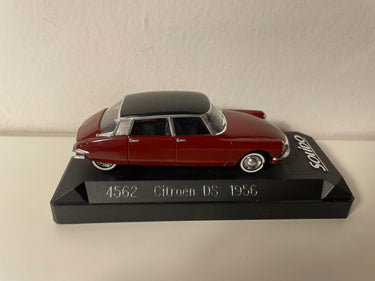


Model Car 1956 Citroën DS Bordeaux with Black Roof - Solido Reference 4562
Echelle: 1/43ème

Your payment information is processed securely.

The 1956 Citroën DS: A Miniaturized Revolution by Solido
This 1956 Citroën DS in Bordeaux with a black roof reproduced by Solido under reference 4562 captures the revolutionary essence of the legendary "Goddess". This 1/43 scale miniature pays homage to one of the most iconic models in the French automotive industry, which shook up the aesthetic and technical codes of its time.
A true collector's item, this faithful reproduction allows car enthusiasts to own a fragment of history, witnessing an era when French innovation shone across the globe.
Miniature Features
- Model: Citroën DS
- Brand: Citroën
- Year: 1956
- Scale: 1/43
- Color: Bordeaux with black roof
- Protective case included: Yes
The DS: An Automotive Revolution
Unveiled at the Paris Motor Show in October 1955 for the 1956 model year, the Citroën DS immediately triggered a seismic shift in the automotive world. Its futuristic lines, designed by Flaminio Bertoni and André Lefèbvre, radically broke away from the aesthetic conventions of the time. Its streamlined silhouette, integrated grille, and faired headlights give it a striking modernity.
Technically, the DS revolutionized the industry with its hydropneumatic suspension, power steering, and assisted disc brakes. These innovations, unprecedented in a production car, offer exceptional ride comfort and road handling. The 1.9-liter 4-cylinder engine develops 75 horsepower, allowing speeds of up to 140 km/h.
The commercial success was immediate: on the first day of the show, Citroën received 12,000 orders. This success confirms the visionary boldness of the brand and marks the beginning of a 20-year career for this iconic model.
Citroën in the 1950s: The Golden Age of Innovation
In the mid-1950s, Citroën went through a period of intense technical creativity. Building on the success of the Traction Avant launched in 1934, the chevron brand established itself as the laboratory of French automotive innovation. André Citroën left a legacy of technical boldness that his successors carry on brilliantly.
This era marks the peak of the Citroën philosophy: to offer revolutionary technical solutions in the service of comfort and safety. The company invests heavily in research and development, not hesitating to take considerable risks to stand out from the competition. The DS perfectly embodies this culture of innovation that characterized the French brand at the time.
However, these colossal investments financially weakened the company, foreshadowing the difficulties that would lead to its merger with Peugeot in the following years. The DS thus represents the swan song of Citroën's creative independence.
The DS and General de Gaulle: A Historic Liaison
The story of the Citroën DS is intimately intertwined with that of the French Fifth Republic. General de Gaulle, who became president in 1958, chose the DS as his official vehicle, significantly enhancing its international prestige. This association between the "Goddess" and the giant of French history forges a unique automotive legend.
The most dramatic episode occurs on August 22, 1962, in Petit-Clamart. During an assassination attempt by the OAS against General de Gaulle, the presidential DS is caught in a hail of bullets. Despite flat tires and a body riddled with bullet holes, the vehicle manages to escape thanks to its hydropneumatic suspension, which maintains stability even with destroyed tires. This episode transforms the DS into a symbol of robustness and reliability.
Beyond the security aspect, the DS becomes the ambassador of French know-how during official trips abroad. Its avant-garde design and exceptional comfort impress world leaders, contributing to the prestige of the French automotive industry. This geopolitical dimension of the DS far exceeds the automotive realm to touch on France's image around the world.
Roland Barthes immortalizes this fascination in his "Mythologies" in 1957, describing the DS as a mythical object of French modernity. This sociological analysis confirms the extraordinary cultural impact of a car that transcends its primary function to become a national symbol.
Complete Your Citroën Miniature Collection
This Citroën DS Solido occupies a central place in the realm of French automotive miniatures. Its quality reproduction and 1/43 scale make it an essential piece for any collector passionate about Citroën miniatures. It naturally interacts with other iconic models like the Traction Avant or the mythical 2CV.
Fans of French miniatures will find in this DS a perfect complement to the Peugeot, Renault, and Simca productions of the same era. Its elegant Bordeaux and black roof livery harmoniously matches the thematic collections of 1950s cars and 1960s cars.
This Solido miniature appeals to both experienced collectors and automotive history enthusiasts eager to own a faithful reproduction of this technical revolution. It also finds its place among fans of exceptional sedans, bearing witness to the golden age of French innovation in the automotive industry.
Frequently Asked Questions
How to understand the scales of miniatures?
Scale indicates the reduction ratio between the real car and the miniature. For example, at 1:43 scale, each centimeter on the miniature corresponds to 43 centimeters on the real vehicle.
Concretely, a 1/18 scale Ferrari model is approximately 25-30 cm long, while in 1/43 scale it measures approximately 10 cm.
What scales are available?
Our model cars are mainly offered in 1/43, 1/24, 1/18 and 1/87 (HO) scales. The scale is always indicated in the product sheet.
The smaller the second number, the larger the model car (e.g. 1/18 is larger than 1/43).
Does the model car come with protection?
Yes, each model car is systematically delivered in its protective box. This box preserves the collectible value and protects your model car from dust and shocks.
How is my package protected during transport?
We package each order with the utmost care: bubble wrap, appropriate cushioning, and polystyrene. Your model car is perfectly secure during its journey.
What is the delivery time?
In-stock items are shipped within 24-48 hours. Please allow 2-3 business days for France via Colissimo or 4-5 days via Mondial Relay.
The model car is no longer in stock, when will you have it?
It's impossible for me to know exactly when I'll receive a new stock because I receive arrivals in dribs and drabs. Please contact me so I can keep you informed as soon as it's available.
What our customers say
Customer feedback and testimonials