


Le dernier exemplaire de cette miniature a ete vendu
Ces autres miniatures pourraient vous interesser
Même marque : Renault


Même origine : française


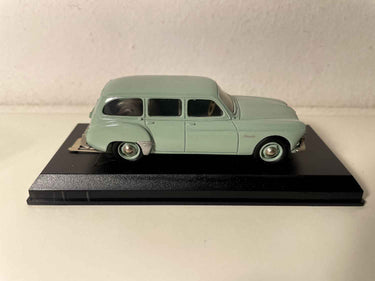


Model Car 1959 Renault Frégate Manoir pale green (ELYSEE collection)
Echelle: 1/43ème

Your payment information is processed securely.
)
Discover this magnificent 1959 Renault Frégate Manoir diecast model car in its stunning pale green shade, faithfully reproduced at 1/43 scale by the prestigious ELYSEE collection. This exceptional miniature captures the elegance and refinement of this iconic French sedan from the 1950s, making it an essential piece for any serious collector of scale model vehicles.
This authentic diecast model car represents far more than a simple collectible—it embodies the French art of living and the automotive craftsmanship of a golden era. With meticulous attention to detail and superior manufacturing quality, this miniature reproduction stands as a testament to the excellence that collectors seek in premium scale models. The pale green finish perfectly recreates the sophisticated color palette favored by discerning French buyers of the late 1950s.
A true jewel for collectors, this Renault Frégate Manoir miniature is a valuable testament to the French art of living and the automotive craftsmanship of the time. It naturally finds its place in any collection dedicated to French miniature cars or classics from 1950 to 1979.
Technical Specifications of This Premium Diecast Model Car
- Model: Renault Frégate Manoir
- Brand: Renault
- Year: 1959
- Scale: 1/43 scale
- Color: Pale green
- Collection: ELYSEE
- Protective casing included: Yes
- Material: High-quality die-cast metal
- Condition: New in original packaging
The Renault Frégate Manoir: An Icon of French Automotive Excellence
Launched in 1951, the Renault Frégate represented the ambition of the Régie Renault to conquer the premium family sedan segment during the post-war reconstruction period. The Manoir version, introduced in 1956 and refined until 1960, embodied the pinnacle of refinement of the range with its careful finishes and remarkable comfort that distinguished it from more utilitarian French vehicles of the era.
This four-door sedan stood out with its elegant lines inspired by American automobiles while retaining a character that was typically French. The design philosophy reflected a unique moment in European automotive history, when manufacturers sought to combine transatlantic sophistication with continental practicality. Its 4-cylinder 1997 cm³ engine developed a respectable power for the time, allowing this Renault Frégate Manoir to deliver satisfying performance on the roads of the era while maintaining the fuel efficiency expected by European drivers.
The interior appointments were particularly noteworthy, featuring high-quality upholstery and wood trim that evoked the luxury limousines of the period. The spacious cabin could comfortably accommodate five adults, making it an ideal vehicle for both family use and professional purposes. The attention to detail in the original vehicle is masterfully captured in this scale model reproduction.
Despite its undeniable qualities and the craftsmanship invested in its production, the Frégate never achieved the commercial success expected in the face of competition from Peugeot and Citroën, making it today a model particularly sought after by enthusiasts of vintage French cars and collectors of rare diecast model cars representing automotive curiosities.
Why This Diecast Model Car Deserves a Place in Your Collection
The 1/43 scale has long been recognized as the collector's scale par excellence for die-cast miniature vehicles. This particular format offers the perfect balance between display practicality and detail reproduction, allowing manufacturers to capture the essence of the original vehicle while maintaining reasonable dimensions for storage and presentation.
The ELYSEE collection is renowned among enthusiasts of die-cast collectibles for its commitment to historical accuracy and manufacturing quality. Each model in the range undergoes rigorous quality control to ensure that proportions, colors, and details faithfully reflect the original vehicle. This diecast model car benefits from advanced manufacturing techniques including precision die-casting, careful paint application, and quality assembly that guarantees long-term durability.
For collectors specializing in French automotive heritage, this Renault Frégate Manoir represents an opportunity to acquire a miniature of a relatively rare model in the real world. While thousands of Citroën DS and Peugeot 404 models were produced, the Frégate remains comparatively uncommon, making this scale model reproduction particularly valuable for those seeking to build a comprehensive collection of French sedans from the 1950s.
Renault in the Transformative Years of the Late 1950s
In 1959, Renault underwent a major transformation period under the leadership of Pierre Dreyfus, who took over the direction of the Régie in 1955. The public company sought to modernize its image and diversify its range to meet the expectations of an increasingly demanding clientele in the consumer boom of post-war France. This period marked a crucial transition between the austerity of the immediate post-war years and the prosperity of the 1960s.
The diamond brand then focused on technical innovation and design to stand out in an increasingly competitive market. Alongside the development of the Frégate, the engineers at Billancourt were already working on the future Renault 4 and Renault 8, which would revolutionize the French automobile market with their innovative approach to affordable family transportation. This pivotal period marks the transition between the legacy of Louis Renault and the industrial modernity of the post-war era.
The company's strategy during this period reflected broader trends in European automotive manufacturing, as traditional luxury models gave way to more democratic vehicles designed for mass production. The Frégate Manoir represents one of the last expressions of Renault's pre-war ambitions before the brand fully embraced the philosophy of practical, affordable vehicles that would define its success in subsequent decades.
An Ambassador of French Luxury and Refinement
The Renault Frégate Manoir was regarded as one of the most refined sedans of its time in France, positioning itself as an accessible alternative to the more expensive Citroën DS. It was frequently chosen by political figures, business leaders, and professionals who appreciated its comfort, presence, and understated elegance. Its spacious interior and plush seats made it a true accessible limousine, offering luxury amenities without the prohibitive cost of prestigious marques.
Remarkably, this automobile was often used as an official vehicle in prefectures and certain French administrations, where its combination of dignity and reliability made it an ideal choice for representing the state. Its pale green color, particularly elegant and distinctive, was one of the most requested shades by a bourgeois clientele keen on distinction without ostentation. This subtle color choice reflected the refined taste of the French upper-middle class of the era.
The term "Manoir" perfectly evoked the French art of living and the architectural heritage of the country, conjuring images of elegant country estates and provincial refinement. This designation reflected Renault's desire to position its sedan as a symbol of French refinement, far removed from the American influence that marked its exterior lines. The marketing strategy emphasized French tradition and quality of life rather than technological prowess or performance.
Paradoxically, despite its qualities and high-end positioning, the Frégate Manoir remains one of the least known Renault models to the general public today, making it an even more precious piece for discerning collectors of both vintage automobiles and die-cast scale models. This relative obscurity adds to its appeal among connoisseurs who value rarity and historical significance.
Building a Comprehensive Collection of French Miniature Automobiles
This Renault Frégate Manoir diecast model car occupies a prime position in the realm of French automobile reproductions and represents an excellent foundation for expanding your collection of vintage French vehicles. It perfectly fits into collections dedicated to Renault miniature cars, allowing for a reflection on the evolution of the diamond brand through its most iconic models across different eras.
Collectors passionate about miniature sedans will find this Frégate Manoir an ideal complement to other major French touring cars of the time. It harmonizes beautifully with contemporary Peugeot and Citroën models, providing a complete overview of the French automobile landscape of the 1950s.
The 1/43 scale allows for easy display alongside other models from the same era, creating visually coherent presentations that tell the story of French automotive evolution. Consider pairing this Renault Frégate with models of the Citroën Traction Avant, Peugeot 203, or Simca Aronde to create a comprehensive display of French sedans from the 1950s transition period.
The Art of Collecting Die-Cast Model Cars: Tips for Enthusiasts
For those new to collecting diecast model cars or looking to enhance their expertise, understanding the key factors that determine a miniature's value and appeal is essential. The condition of the model, the completeness of the original packaging, the rarity of the production run, and the historical significance of the vehicle all contribute to a model's desirability among collectors.
When adding a piece like this Renault Frégate Manoir to your collection, consider how it complements your existing models and fills gaps in your representation of automotive history. Thematic collecting—whether focused on a specific brand, era, country of origin, or vehicle type—creates more coherent and valuable collections than random accumulation.
Proper storage and display are crucial for maintaining the value of your die-cast collectibles. Keep models away from direct sunlight to prevent paint fading, maintain moderate temperature and humidity levels to avoid material degradation, and handle pieces carefully to preserve delicate details. The included protective casing for this model provides excellent protection when not on display.
Investment Potential of Vintage French Diecast Model Cars
While the primary motivation for collecting should always be passion and appreciation for automotive history, it's worth noting that well-chosen scale model cars can appreciate in value over time. Models of rare or historically significant vehicles, limited production runs, and pieces from prestigious manufacturers tend to perform best as investments.
The Renault Frégate Manoir's relative obscurity in the collector market, combined with its historical significance as one of Renault's last attempts at the luxury sedan segment before shifting to more democratic vehicles, suggests potential for value appreciation. As fewer original Frégate automobiles survive and interest in preserving French automotive heritage grows, miniature reproductions become increasingly important as historical documents.
Collectors should view their acquisitions with a long-term perspective, recognizing that the die-cast collectibles market can fluctuate based on broader economic conditions, generational preferences, and trends in automotive enthusiasm. The most successful collectors combine financial acumen with genuine passion for their subject matter.
Frequently Asked Questions About This Diecast Model Car
What makes the 1/43 scale ideal for collectors?
The 1/43 scale represents the traditional standard for die-cast model cars, established in the 1930s and maintained as the preferred scale for serious collectors. This size offers excellent detail reproduction while remaining practical for display and storage. A 1/43 scale model typically measures between 8 and 12 centimeters in length, making it easy to build substantial collections without requiring excessive space.
How should I care for my diecast model cars?
Proper care ensures your miniature vehicles retain their value and appearance for decades. Store models in their original packaging when not displayed, keep them away from direct sunlight and extreme temperatures, dust them gently with a soft brush, and avoid handling them excessively. The paint and decals on quality die-cast models are durable but not indestructible, so gentle treatment is essential.
Is the ELYSEE collection well-regarded among collectors?
The ELYSEE collection has earned respect in the die-cast community for producing faithful reproductions of classic European vehicles with attention to historical accuracy. While it may not achieve the same premium status as brands like Minichamps or AutoArt, ELYSEE models offer excellent quality at accessible prices, making them ideal for both beginning collectors and experienced enthusiasts seeking to fill gaps in their collections.
Why is the Renault Frégate Manoir relatively unknown today?
Despite its qualities, the Frégate never achieved commercial success comparable to its competitors from Peugeot and Citroën. Its production ended in 1960 after relatively modest sales numbers, and few examples survive today. This limited presence in the collective automotive memory makes it a fascinating subject for collectors who appreciate discovering overlooked chapters of automotive history.
What other French sedans from the 1950s complement this model?
To create a comprehensive collection of French sedans from this era, consider adding models of the Citroën 15-Six, Peugeot 203 and 403, Simca Aronde, Panhard Dyna, and of course the revolutionary Citroën DS. These vehicles represent the diversity of approaches taken by French manufacturers during the crucial post-war reconstruction period.
Historical Context: French Automotive Industry in 1959
Understanding the broader context of French automotive manufacturing in 1959 enhances appreciation for models like the Renault Frégate Manoir. This period saw French manufacturers transitioning from post-war austerity to the prosperity of the economic boom known as the "Trente Glorieuses" (Thirty Glorious Years). Consumer expectations were evolving rapidly, with buyers seeking not just transportation but comfort, style, and social status.
The French automotive market of 1959 was characterized by intense competition between the major domestic manufacturers—Renault, Citroën, Peugeot, and Simca—each pursuing different strategies. Citroën emphasized innovation with the revolutionary DS, Peugeot focused on robust engineering and conservative styling, while Renault struggled to define its position in the luxury segment before ultimately retreating to focus on more popular vehicles.
This historical richness makes diecast model cars from this era particularly valuable to collectors, as they represent not just individual vehicles but entire chapters in the story of European industrial development and social change.
Resources for Diecast Model Car Collectors
For enthusiasts seeking to deepen their knowledge of die-cast collectibles and French automotive history, numerous resources are available. Online forums and collector communities provide valuable information about model variations, manufacturer histories, and market values. Specialized publications document the evolution of miniature vehicle manufacturing and the stories behind the full-size automobiles they represent.
This piece is particularly aimed at experienced collectors and enthusiasts of French automotive history, who will appreciate the rarity and authenticity of this faithful reproduction of a model that has become legendary precisely because of its discretion. Whether displayed individually in a place of honor or integrated into a larger collection of French sedans, this Renault Frégate Manoir diecast model car offers lasting enjoyment and historical significance.
By acquiring this exquisite miniature, you're not simply adding another piece to your collection—you're preserving a fragment of French automotive heritage and celebrating the craftsmanship of an era when manufacturers pursued ambitious visions even at the risk of commercial failure. The Renault Frégate Manoir may not have achieved the success its creators hoped for, but through scale model reproductions like this one, its elegance and refinement continue to be appreciated by discerning collectors worldwide.
Frequently Asked Questions
How to understand the scales of miniatures?
Scale indicates the reduction ratio between the real car and the miniature. For example, at 1:43 scale, each centimeter on the miniature corresponds to 43 centimeters on the real vehicle.
Concretely, a 1/18 scale Ferrari model is approximately 25-30 cm long, while in 1/43 scale it measures approximately 10 cm.
What scales are available?
Our model cars are mainly offered in 1/43, 1/24, 1/18 and 1/87 (HO) scales. The scale is always indicated in the product sheet.
The smaller the second number, the larger the model car (e.g. 1/18 is larger than 1/43).
Does the model car come with protection?
Yes, each model car is systematically delivered in its protective box. This box preserves the collectible value and protects your model car from dust and shocks.
How is my package protected during transport?
We package each order with the utmost care: bubble wrap, appropriate cushioning, and polystyrene. Your model car is perfectly secure during its journey.
What is the delivery time?
In-stock items are shipped within 24-48 hours. Please allow 2-3 business days for France via Colissimo or 4-5 days via Mondial Relay.
The model car is no longer in stock, when will you have it?
It's impossible for me to know exactly when I'll receive a new stock because I receive arrivals in dribs and drabs. Please contact me so I can keep you informed as soon as it's available.
What our customers say
Customer feedback and testimonials