


Le dernier exemplaire de cette miniature a ete vendu
Ces autres miniatures pourraient vous interesser
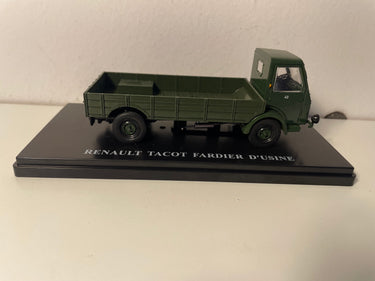


Model Car Renault tacot factory tractor
Echelle 1/43ème
Le blister a été découpé afin de sortir le véhicule pour les photos (blister rescotché au carton )

Your payment information is processed securely.

Discover this exceptional reproduction of the Renault tacot factory tractor, a rare piece that immortalizes the early steps of the French automotive industry. This miniature captures the essence of utility vehicles from the early 20th century, showcasing the ingenuity and craftsmanship of the diamond brand.
A true collector's item, this faithful reproduction will appeal to enthusiasts of vintage cars and collectors searching for authentic pieces representing French industrial heritage.
Features of the miniature
- Model: Factory tractor
- Brand: Renault
- Year: Early 1900s
- Scale: 1/43
- Color: Original factory delivery
- Protective case included: Yes
The factory tractor, a pioneer of industrial transport
The Renault factory tractor represents a crucial milestone in the evolution of industrial transport in the early 20th century. Designed to meet the growing needs of factories and workshops, this utility vehicle embodied the transition from horse-drawn transport to modern motorization. Its robust chassis and simple yet effective design made it an indispensable work tool.
Powered by a single-cylinder engine with modest power yet sufficient for its time, the tractor distinguished itself by its remarkable load capacity and reliability. Its flatbed allowed for transporting heavy materials, machinery, or various goods, thereby revolutionizing industrial logistics of the era.
This pioneering vehicle foreshadowed Renault's future developments in the field of utility vehicles, a segment that would become one of the French brand's specialties throughout the 20th century.
Renault, the birth of an automotive empire
When the factory tractor was born, Renault was still a young company founded in 1898 by Louis Renault and his brothers Marcel and Fernand. The company was already distinguished by its innovative approach and ability to identify the emerging needs of the nascent automotive market. This pivotal period marked the beginning of a success story that would last over a century.
Louis Renault, a true automotive visionary, understood the importance of the utility and commercial sector. Alongside the development of passenger cars, he invested in designing robust and practical commercial vehicles. This diversified strategy allowed the brand to position itself across all segments of the emerging automotive market.
The Billancourt factory, the birthplace of Renault production, saw the creation of revolutionary vehicles that would help shape the French automotive industry. The factory tractor perfectly fit this pragmatic innovation approach characteristic of Renault's DNA.
A silent revolution in the streets of Paris
The arrival of the first Renault factory tractors in the streets of Paris in the early 1900s did not go unnoticed. These strange motorized vehicles, progressively replacing horse-drawn carts, sparked curiosity and sometimes distrust among Parisians. Coachmen, seeing their profession threatened by these noisy machines, openly expressed their hostility.
One anecdote recounts how a Renault tractor, delivering metal parts for the construction of the Paris Métro, was confronted by a group of disgruntled coachmen near Les Halles. The incident, widely reported by the press of the time, perfectly illustrated the social tensions generated by this technological revolution.
Paradoxically, it was due to its robustness and reliability that the factory tractor eventually won over even the most skeptical. Craftsmen and merchants in Paris quickly discovered the advantages of this new means of transport: No food to provide, no rest required, and above all, a load capacity greater than that of draft horses.
This silent revolution was already transforming the French urban landscape, paving the way for the rise of modern automotive society. The Renault factory tractor was thus, on its modest scale, part of one of the most significant shifts in transportation history.
Complete your miniature collection
This reproduction of the Renault factory tractor occupies a unique place in the world of French automotive miniatures. It perfectly represents the pioneering spirit of the nascent automotive industry and constitutes an ideal complement to collections focused on automotive history. Its rarity makes it a particularly sought-after piece among passionate collectors of 1910s automobiles.
This miniature finds its rightful place alongside other historical models in the Renault collection, creating a fascinating timeline of the brand's technological evolution. Fans of advertising vehicles and light utilities will also find a valuable testimony to the origins of motorized commercial transport.
Intended for demanding collectors and automobile history enthusiasts, this reproduction particularly appeals to those who appreciate the authenticity and heritage value of miniatures. It also serves as an excellent starting point to discover the world of vintage French automobiles and their rich industrial heritage.
Frequently Asked Questions
How to understand the scales of miniatures?
Scale indicates the reduction ratio between the real car and the miniature. For example, at 1:43 scale, each centimeter on the miniature corresponds to 43 centimeters on the real vehicle.
Concretely, a 1/18 scale Ferrari model is approximately 25-30 cm long, while in 1/43 scale it measures approximately 10 cm.
What scales are available?
Our model cars are mainly offered in 1/43, 1/24, 1/18 and 1/87 (HO) scales. The scale is always indicated in the product sheet.
The smaller the second number, the larger the model car (e.g. 1/18 is larger than 1/43).
Does the model car come with protection?
Yes, each model car is systematically delivered in its protective box. This box preserves the collectible value and protects your model car from dust and shocks.
How is my package protected during transport?
We package each order with the utmost care: bubble wrap, appropriate cushioning, and polystyrene. Your model car is perfectly secure during its journey.
What is the delivery time?
In-stock items are shipped within 24-48 hours. Please allow 2-3 business days for France via Colissimo or 4-5 days via Mondial Relay.
The model car is no longer in stock, when will you have it?
It's impossible for me to know exactly when I'll receive a new stock because I receive arrivals in dribs and drabs. Please contact me so I can keep you informed as soon as it's available.
What our customers say
Customer feedback and testimonials