


Le dernier exemplaire de cette miniature a ete vendu
Ces autres miniatures pourraient vous interesser
Même métier : services publics


Même marque : Citroën


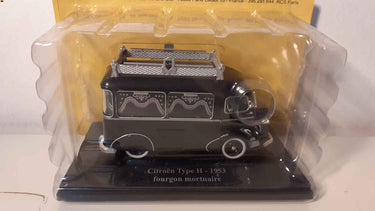


Model Car 1953 black Citroën Type H mortuary van
1953 black Citroën Type H mortuary van
Scale: 1/43
the blister was cut from the cardboard and re-taped

Your payment information is processed securely.

An exceptional model car: the 1953 Citroën Type H mortuary van
This black 1953 Citroën Type H model car represents one of the most unique versions of the iconic French utility vehicle. Transformed into a funeral van, this model perfectly illustrates the exceptional versatility of the Type H and its deep integration into the French social fabric of the time. This collector's item is an authentic testimony to a little-known but essential part of French automotive history.
A faithful reproduction of a vehicle that marked its era, this model car is aimed at collectors passionate about automotive history and fans of French commercial vehicles. It accurately captures the unique characteristics of this specialized version of the Type H, which has today become a symbol of French ingenuity in vehicle adaptation.
Characteristics of the model car
- Model: Citroën Type H mortuary van
- Brand: Citroën
- Year: 1953
- Scale: 1/43
- Color: Black
- Protective case included: Yes
The Citroën Type H: revolution of the French utility vehicle
Launched in 1947, the Citroën Type H revolutionized the French utility vehicle market with its avant-garde design. Designed by engineer Flaminio Bertoni, this van was distinguished by its all-metal monocoque body and characteristic rounded shapes. Its unique silhouette, affectionately nicknamed "pig's nose" by the French, quickly became recognizable on all the country's roads.
The 1953 Type H benefits from the first improvements made to the original model, particularly in terms of the engine and interior finishes. Its modular design allows for remarkable adaptation to many professional uses , from commercial deliveries to public services, including the most specialized applications such as mortuary vans. This exceptional versatility makes the Type H a true Swiss Army knife of commercial motoring.
The Type H's commercial success is based on its legendary robustness and ease of maintenance. Produced until 1981, it represents one of the longest careers in French automotive history, testifying to the relevance of its original design and its ability to evolve over the decades.
Citroën: pioneer of automotive innovation
In 1953, Citroën consolidated its position as an innovative manufacturer under the leadership of André Citroën and later Pierre-Jules Boulanger. The chevron brand, founded in 1919, was already establishing itself as a technological pioneer with revolutionary models like the Traction Avant. This philosophy of innovation is fully reflected in the design of the Type H, which completely rethought the approach to commercial vehicles.
The year 1953 marked a pivotal period for Citroën, which simultaneously developed its passenger car and utility vehicle ranges. The French brand cultivated its avant-garde identity by offering bold technical solutions, such as the hydropneumatic suspension that would soon equip its flagship models. This constant search for technical innovation is reflected in every detail of the Type H, from the choice of materials to the optimization of the cargo space.
Citroën's international expansion accelerated during this decade, exporting French expertise to new markets. The Type H thus became an ambassador of French engineering throughout the world, helping to forge the brand's reputation for technical excellence.
An unexpected vocation: the Type H at the service of the last journey
The adaptation of the Citroën Type H into a funeral van perfectly illustrates the ingenuity of French coachbuilders in the 1950s. These specialized craftsmen transformed the versatile platform of the Type H to meet the specific needs of funeral homes, creating vehicles that were both dignified and practical. The color black, traditionally associated with mourning, emphasizes the respect and solemnity required for this particular mission.
These specialized versions demonstrate the Type H's extraordinary adaptability to a wide variety of applications. Coachbuilders developed custom-made fittings, including coffin guidance systems, storage spaces for funeral accessories, and sometimes even refrigerated compartments. This French artisanal expertise helps make the Type H a truly universal vehicle.
The social history of these funeral vans reveals their essential role in the evolution of French funeral practices. Gradually replacing horse-drawn hearses, they modernized funeral services while preserving the traditional dignity of the final journey . Some of these vehicles, carefully maintained, continue to serve family businesses today, perpetuating a century-old tradition.
These mortuary Type Hs have become objects of fascination for collectors, representing a little-known but authentic part of French automotive history. Their current rarity and their particular symbolic significance make them sought-after pieces, witnesses to an era when the French automobile adapted to all of society's needs.
Complete your collection of French model cars
This model car of the Citroën Type H mortuary van naturally finds its place alongside other iconic French utility vehicles. It fits perfectly into a collection dedicated to Type H model cars or French light utility vehicles , creating a cohesive ensemble representative of French industrial ingenuity.
Collectors will appreciate complementing this piece with other Citroën model cars from the same period, notably the commercial versions of the Type H or contemporary touring models. This thematic approach allows the reconstruction of the French automotive world of the 1950s , a prosperous period of creativity and innovation for the national industry.
The 1/43 scale makes it easy to integrate this model car into existing collections, this size having become the reference for demanding collectors . Its careful finish and historical authenticity make it a piece of choice for lovers of French model cars , whether they are passionate about automotive history, specialized collectors or simply sensitive to French industrial heritage. This model car also constitutes an excellent entry point to discover the fascinating world of vintage vehicles and their role in the evolution of French society.
Frequently Asked Questions
How to understand the scales of miniatures?
Scale indicates the reduction ratio between the real car and the miniature. For example, at 1:43 scale, each centimeter on the miniature corresponds to 43 centimeters on the real vehicle.
Concretely, a 1/18 scale Ferrari model is approximately 25-30 cm long, while in 1/43 scale it measures approximately 10 cm.
What scales are available?
Our model cars are mainly offered in 1/43, 1/24, 1/18 and 1/87 (HO) scales. The scale is always indicated in the product sheet.
The smaller the second number, the larger the model car (e.g. 1/18 is larger than 1/43).
Does the model car come with protection?
Yes, each model car is systematically delivered in its protective box. This box preserves the collectible value and protects your model car from dust and shocks.
How is my package protected during transport?
We package each order with the utmost care: bubble wrap, appropriate cushioning, and polystyrene. Your model car is perfectly secure during its journey.
What is the delivery time?
In-stock items are shipped within 24-48 hours. Please allow 2-3 business days for France via Colissimo or 4-5 days via Mondial Relay.
The model car is no longer in stock, when will you have it?
It's impossible for me to know exactly when I'll receive a new stock because I receive arrivals in dribs and drabs. Please contact me so I can keep you informed as soon as it's available.
What our customers say
Customer feedback and testimonials