


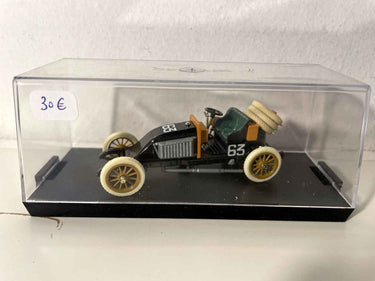


Model Car Renault 40 HP black number 63 - 1963 Paris-Madrid rally - BRUMM
Echelle: 1/43ème
Pilote: Marcel Renault
Boitier fissuré (2 cm) sur le dessus

Your payment information is processed securely.

Chargement de vos recommandations...
The Renault 40 HP black number 63 by BRUMM takes us back to the heroic early days of car racing, immortalizing one of the most dramatic moments in the history of French motorsport. This exceptional diecast model car faithfully reproduces the vehicle that participated in the infamous Paris-Madrid rally of 1903, forever marking the history of the diamond brand. For collectors passionate about automotive heritage, this miniature represents far more than a simple scale model – it embodies a pivotal moment when courage and mechanical innovation collided on the dusty roads of early 20th century Europe.
This 1/43 scale reproduction captures the raw elegance of the early racing cars, bearing witness to a time when every competition was an adventure into the unknown. The level of detail achieved by BRUMM transforms this diecast model car into a genuine museum piece, perfect for enthusiasts who appreciate authenticity and historical accuracy. Each element, from the exposed mechanical components to the racing number, has been meticulously crafted to honor Marcel Renault's legacy. A true gem for automotive history enthusiasts and collectors of Renault miniature cars.
Technical Specifications of This Collectible Model
- Model: Renault 40 HP number 63
- Brand: Renault
- Historical Year: 1903
- Scale: 1/43
- Color: Black with period-accurate finish
- Manufacturer: BRUMM (renowned Italian specialist)
- Driver: Marcel Renault
- Competition: Paris-Madrid Rally 1903
- Materials: Die-cast metal with precision detailing
- Protective case included: Yes
- Limited production: Collectible series
The Original Model in Automotive History
The Renault 40 HP of 1903 represents the culmination of the early technical research by Louis and Marcel Renault, two visionary brothers who transformed the nascent automobile industry. Equipped with a four-cylinder engine developing an impressive 40 horsepower – a remarkable achievement for the era – this revolutionary automobile incorporated innovations that would define the brand's reputation for decades to come. The implementation of shaft drive and direct gear transmission positioned Renault at the forefront of automotive engineering, replacing the less reliable chain-drive systems used by competitors.
This racing car stood among the most powerful machines of its time, capable of reaching speeds exceeding 100 km/h on the unforgiving, poorly maintained roads that characterized the early 20th century. Imagine the audacity required to pilot such a vehicle at these velocities when road infrastructure barely existed, and safety equipment remained rudimentary at best. Its slender body and rigid chassis made it a formidable competitor in pure speed trials, perfectly embodying the pioneering spirit that drove the Renault brothers to push the boundaries of what was mechanically possible.
The vehicle testifies to a transformative period when the automobile transitioned from an object of curiosity reserved for the wealthy elite to a true means of future transport with revolutionary potential. French manufacturers, particularly Renault, Panhard, and Peugeot, led global innovation in this emerging field, establishing Europe as the epicenter of automotive development. This diecast model car serves as a tangible connection to that extraordinary era of experimentation and bold engineering.
Renault in 1903: The Pioneers of Billancourt
In 1903, Renault Frères (Renault Brothers) was still a young company founded just four years earlier in 1899 by Louis, Marcel, and Fernand Renault. Operating from their facilities in Billancourt, a suburb of Paris, the company was experiencing remarkable growth, transitioning from artisanal production in a modest workshop to a burgeoning automobile industry with genuine international ambitions. Marcel Renault, passionate about racing and convinced of its commercial value, recognized that automobile competition provided the best platform to test and promote the brand's technical innovations while capturing public imagination.
The Renault brothers had revolutionized the burgeoning industry with several groundbreaking technical innovations. Their signature shaft and drive shaft transmission favorably replaced the chains used by competitors, offering improved reliability and reduced maintenance. This innovation alone justified the brothers' reputation as forward-thinking engineers willing to challenge conventional wisdom. The prosperous period between 1899 and 1903 saw Renault establish itself as one of the most innovative manufacturers in Europe, competing directly with prestigious German manufacturers like Mercedes and Italian rivals such as Fiat.
The family business placed extraordinary importance on automobile racing as a means to bolster both technical reputation and commercial visibility. Marcel Renault personally invested himself in this performance-driven communication strategy, regularly taking the wheel in major competitions. His tragic death during the 1903 Paris-Madrid rally would deeply affect the company and the entire French automotive community, but his legacy of innovation and competitive spirit would endure in every vehicle bearing the Renault name.
The Drama of the Paris-Madrid 1903: A Race That Changed History
The Paris-Madrid rally of 1903 was conceived as the apotheosis of nascent automobile racing, designed to captivate European imagination and demonstrate the capabilities of modern motorcars. Attracting the continent's finest drivers, this ambitious event proposed a grueling course of over 1,000 kilometers from Paris to Madrid, traversing diverse French terrain before crossing into Spain. Marcel Renault, piloting his 40 HP number 63, numbered among the race favorites, his previous successes and technical expertise making him a formidable contender in this prestigious event that had captured the attention of all Europe.
The race promised to serve as both a formidable technical laboratory for automotive innovation and an exceptional showcase for participating manufacturers. Thousands of spectators lined the route, eager to witness these mechanical marvels pushing the limits of speed and endurance. Unfortunately, this historic competition transformed into a nightmare that would forever alter motorsport history. The dusty, unpaved roads combined with crowds of careless spectators and excessive speeds for the time created catastrophic conditions that led to numerous tragic accidents involving both drivers and bystanders.
Marcel Renault himself lost his life near Angoulême (not far from Poitiers) in the early morning hours of May 25, 1903, when his vehicle left the road at high speed, possibly blinded by dust clouds raised by preceding competitors. The accident mourned the entire French automotive community and dealt a devastating personal blow to Louis Renault, who lost not only his brother and business partner but also a close friend and fellow innovator. Marcel was only 30 years old, his brilliant career cut tragically short at the height of his creative powers.
This dramatic event marked an irreversible turning point in French motorsport history and regulation. Following multiple fatalities, authorities definitively stopped the race at Bordeaux, declaring it impossible to continue to Madrid under such dangerous conditions. Never again would such long-distance races be held on open public roads with inadequate safety measures. The death of Marcel Renault, a pioneer and visionary whose technical contributions had reshaped the industry, deprived French automotive engineering of one of its brightest innovators. However, his technical legacy endured in all subsequent achievements of the diamond brand, with Louis Renault continuing their shared vision.
This tragedy paradoxically contributed to the evolution of sports regulations toward greater safety consciousness, foreshadowing the modern organization of motorsport on closed, controlled circuits with proper medical support and safety infrastructure. The Renault 40 HP number 63 thus remains a poignant symbol of that heroic era when the automobile was still seeking its limits, and brave individuals like Marcel Renault risked everything to advance automotive progress. This diecast model car preserves that memory, allowing collectors to honor both the vehicle's technical achievements and the courage of those early racing pioneers.
Why BRUMM Excels in Historical Miniature Production
BRUMM, the Italian manufacturer behind this exceptional scale model, has earned an international reputation among discerning collectors of historical racing miniatures. Founded in 1972, the company specializes in reproducing vehicles from automotive history's golden age, with particular emphasis on early racing cars and classic European automobiles. Their commitment to historical accuracy extends beyond superficial appearance to include period-correct details that satisfy even the most demanding collectors.
What distinguishes BRUMM in the competitive world of diecast model cars is their meticulous research process. Before producing each model, their team consults period photographs, technical drawings, and when possible, examines surviving original vehicles. This dedication ensures that every miniature faithfully reproduces not just the general appearance but also specific details like spoke patterns, dashboard layouts, and mechanical components. For the Renault 40 HP, this means accurate representation of the exposed drivetrain, the distinctive early 1900s bodywork, and the racing accoutrements that characterized competition vehicles of the era.
The choice of 1/43 scale represents the perfect compromise for historical vehicles, offering sufficient size to appreciate intricate details while remaining practical for display and storage. This scale has become the standard among serious collectors of vintage racing cars, creating a cohesive collection aesthetic when multiple models are displayed together. BRUMM's expertise in this specific scale has made them a preferred choice for enthusiasts seeking authentic representations of automotive history's most significant moments.
Building Your Collection of Historical Racing Miniatures
This Renault 40 HP BRUMM diecast model car occupies a special position in the world of historical miniatures, perfectly representing that pioneering era when every race constituted an adventure into uncharted territory. It naturally fits into collections dedicated to 1900s automobiles or historical racing cars, serving as an anchor piece that contextualizes other models from the heroic age of motorsport.
Collectors passionate about automotive history will particularly appreciate how this piece harmoniously dialogues with other models from the era. Consider pairing it with early Peugeot racing cars that competed in the same Paris-Madrid rally, or with contemporary Panhard and Levassor vehicles that represented Renault's primary French competition. Together, these miniatures recreate the competitive landscape of early 1900s motorsport, allowing collectors to understand the technical evolution and rivalry that drove innovation.
The beauty of collecting scale model cars from this period lies in their historical significance beyond mere automotive interest. Each piece represents a chapter in the broader story of technological progress, social transformation, and human ambition. The transition from horse-drawn transport to motorized vehicles fundamentally altered human civilization, and these early racing cars served as the test beds for innovations that would eventually reach everyday consumers. Displaying this collection becomes an educational experience, illustrating how engineering advances in competition vehicles influenced mainstream automotive development.
Display and Preservation Recommendations for Collectors
Properly displaying and preserving diecast model cars ensures they maintain their value and appearance for generations. This BRUMM Renault 40 HP arrives with a protective case, demonstrating the manufacturer's understanding of collectors' needs. However, additional considerations can enhance both presentation and conservation. Position your miniatures away from direct sunlight, which can fade paint finishes over time, particularly on black models where discoloration becomes especially noticeable.
Consider investing in a quality display cabinet with glass doors that protects against dust accumulation while allowing full visibility of your collection. LED lighting specifically designed for display cases can dramatically enhance visual impact without generating the heat associated with traditional bulbs that might damage delicate painted surfaces. For historically significant pieces like this Renault 40 HP, creating thematic displays with period photographs, race programs, or other memorabilia can provide context that enriches the overall presentation.
Temperature and humidity control matter more than many collectors realize. Excessive humidity can cause metal components to oxidize, while extreme dryness may affect paint adhesion. Maintaining stable environmental conditions – typically 18-22°C (65-72°F) with 40-50% relative humidity – creates ideal preservation conditions. Regular, gentle dusting with soft brushes designed for delicate collectibles prevents buildup without risking damage to fine details. These practices ensure your diecast model car collection remains pristine for decades to come.
The Investment Value of Vintage Racing Miniatures
While the primary motivation for collecting should always be personal passion rather than financial speculation, vintage racing miniatures from respected manufacturers like BRUMM have demonstrated consistent appreciation over time. Limited production runs, discontinuation of certain models, and growing interest in early automotive history have combined to create a robust secondary market. Models representing historically significant events – such as the tragic 1903 Paris-Madrid rally – often command premium prices among collectors seeking pieces with compelling narratives.
The key factors influencing long-term value include manufacturer reputation, historical significance, condition, and completeness (including original packaging and documentation). BRUMM's established reputation for quality and accuracy positions their productions favorably for value retention. The Renault 40 HP's connection to a pivotal motorsport tragedy adds emotional and historical weight that purely technical reproductions cannot match. Collectors seeking investment-grade pieces should maintain all original packaging, avoid handling the model directly (use cotton gloves when necessary), and document provenance through purchase receipts and certificates of authenticity.
That said, the greatest return on investment in diecast model car collecting comes from personal enjoyment rather than financial gain. These miniatures offer opportunities for learning, aesthetic pleasure, and connection with communities of like-minded enthusiasts. They serve as tangible links to automotive history, allowing collectors to own representations of vehicles they could never acquire in full scale. The knowledge gained through researching each model's history, the satisfaction of completing thematic collections, and the joy of sharing this passion with fellow enthusiasts provide rewards that transcend monetary value.
Understanding the Paris-Madrid Rally's Legacy in Motorsport
The catastrophic conclusion of the 1903 Paris-Madrid rally fundamentally transformed competitive motorsport, establishing principles that govern racing to this day. The event's tragedies convinced authorities that uncontrolled racing on public roads posed unacceptable risks to both participants and spectators. This realization led directly to the development of purpose-built racing circuits – closed courses with safety barriers, medical facilities, and controlled spectator access that characterize modern motorsport venues.
The rally's legacy extends beyond safety regulations to influence automotive development more broadly. The extreme conditions exposed weaknesses in vehicle design, leading manufacturers to prioritize reliability alongside raw performance. Renault's subsequent vehicles incorporated lessons learned from the 40 HP's competition experience, including improved braking systems, more robust suspension designs, and enhanced driver visibility. These refinements eventually filtered into production vehicles, demonstrating how racing genuinely improved everyday automobiles.
From a cultural perspective, the Paris-Madrid rally represented the last gasp of genuinely adventurous automotive competition before the sport matured into more controlled forms. The romantic notion of brave individuals piloting powerful machines across vast distances on public roads captured popular imagination in ways that later circuit racing, for all its technical sophistication, could never quite replicate. This diecast model car helps preserve the memory of that brief, intense period when motorsport existed at the intersection of sport, adventure, and technological experimentation.
Frequently Asked Questions About This Historical Miniature
What makes this BRUMM Renault 40 HP special compared to other 1/43 scale models?
This miniature stands out through its connection to a pivotal moment in motorsport history – the tragic 1903 Paris-Madrid rally that claimed Marcel Renault's life and changed racing forever. BRUMM's reputation for historical accuracy ensures period-correct details that satisfy demanding collectors. The combination of technical precision, historical significance, and emotional narrative creates a collectible that transcends ordinary scale models to become a genuine piece of automotive heritage.
Is this suitable for children or strictly for adult collectors?
While technically a diecast model car, this piece is definitively designed for adult collectors rather than children's play. The delicate details, historical value, and collector-grade construction make it inappropriate for young children. However, it can serve as an educational tool for older children interested in automotive history, provided they understand its collectible nature and handle it with appropriate care. The included protective case suggests the manufacturer's intention for display rather than active play.
How does the 1/43 scale compare to other common miniature scales?
The 1/43 scale occupies a sweet spot in model car collecting, offering a favorable balance between detail and practicality. Larger scales like 1/18 provide more intricate details but require significantly more display space and typically cost considerably more. Smaller scales like 1/64 are more affordable and space-efficient but sacrifice fine details. At 1/43, this Renault measures approximately 10 centimeters (4 inches) in length, allowing collectors to appreciate mechanical details while maintaining a manageable collection footprint. This scale has dominated European collecting traditions for decades, making it ideal for those building comprehensive historical collections.
Will this model increase in value over time?
While no investment guarantees exist in collectibles markets, several factors suggest favorable long-term prospects for this miniature. BRUMM's established reputation, the model's historical significance, and growing interest in early automotive history create positive conditions for value retention and potential appreciation. Models representing historic tragedies often command premium prices among serious collectors. However, value depends heavily on condition, completeness, and market trends. Collectors should prioritize personal passion over financial speculation, considering any appreciation a pleasant bonus rather than the primary motivation for acquisition.
Can this model be integrated with miniatures from other manufacturers?
Absolutely. The standard 1/43 scale ensures compatibility with miniatures from numerous manufacturers including Spark, IXO, Rio, and others specializing in historical vehicles. This allows collectors to build comprehensive displays representing complete racing grids from specific events or entire eras of automotive development. The consistent scale creates visual harmony when multiple models are displayed together, whether recreating the 1903 Paris-Madrid starting lineup or illustrating the evolution of Renault racing cars across decades.
Expanding Your Knowledge of Early Automotive History
For collectors seeking to deepen their understanding of the era this diecast model car represents, numerous resources provide valuable context. The Motor Sport Magazine archives contain period accounts and historical analyses of early racing events including the Paris-Madrid rally. Academic institutions like the Cité de l'Automobile in Mulhouse, France, maintain extensive collections of early vehicles and documentation that bring the 1900s automotive landscape to vivid life.
Reading contemporary accounts from drivers and spectators provides irreplaceable insights into the experience of early racing. The combination of excitement and danger, the primitive mechanical reliability, and the sheer audacity required to compete at speeds that today seem modest but were then terrifying – these elements emerge vividly from period sources. Understanding this context transforms a simple miniature into a portal connecting modern collectors with those brave pioneers who risked everything to advance automotive progress.
Conclusion: More Than a Miniature, A Historical Testament
The BRUMM Renault 40 HP black number 63 represents far more than an attractive diecast model car for display. It serves as a three-dimensional history lesson, a tribute to fallen pioneers, and a reminder of the courage required to advance technology in its infancy. Every detail – from the exposed mechanical components to the racing number that identifies it as Marcel Renault's ill-fated mount – tells part of a larger story about ambition, innovation, and the human cost of progress.
For collectors of Renault miniature cars, this piece anchors any collection focused on the brand's early competition heritage. For enthusiasts of 1900s automobiles, it exemplifies the technological optimism and engineering ambition that characterized the era. And for students of historical racing cars, it commemorates a watershed moment that transformed motorsport from adventurous expeditions into controlled competitions.
Acquiring this miniature means joining a community of collectors who understand that these small objects carry enormous historical weight. They preserve memories of individuals who shaped our modern world, commemorate events that changed entire industries, and maintain connections to an era when the future remained gloriously uncertain and every mechanical advance represented a genuine leap into the unknown. Whether displayed individually with appropriate contextual materials or integrated into a broader collection spanning automotive history, this BRUMM Renault 40 HP black number 63 enriches any collection with both its physical beauty and its profound historical significance.
Même compétition : rallye


Même marque : Renault


Frequently Asked Questions
How to understand the scales of miniatures?
Scale indicates the reduction ratio between the real car and the miniature. For example, at 1:43 scale, each centimeter on the miniature corresponds to 43 centimeters on the real vehicle.
Concretely, a 1/18 scale Ferrari model is approximately 25-30 cm long, while in 1/43 scale it measures approximately 10 cm.
What scales are available?
Our model cars are mainly offered in 1/43, 1/24, 1/18 and 1/87 (HO) scales. The scale is always indicated in the product sheet.
The smaller the second number, the larger the model car (e.g. 1/18 is larger than 1/43).
Does the model car come with protection?
Yes, each model car is systematically delivered in its protective box. This box preserves the collectible value and protects your model car from dust and shocks.
How is my package protected during transport?
We package each order with the utmost care: bubble wrap, appropriate cushioning, and polystyrene. Your model car is perfectly secure during its journey.
What is the delivery time?
In-stock items are shipped within 24-48 hours. Please allow 2-3 business days for France via Colissimo or 4-5 days via Mondial Relay.
The model car is no longer in stock, when will you have it?
It's impossible for me to know exactly when I'll receive a new stock because I receive arrivals in dribs and drabs. Please contact me so I can keep you informed as soon as it's available.
What our customers say
Customer feedback and testimonials